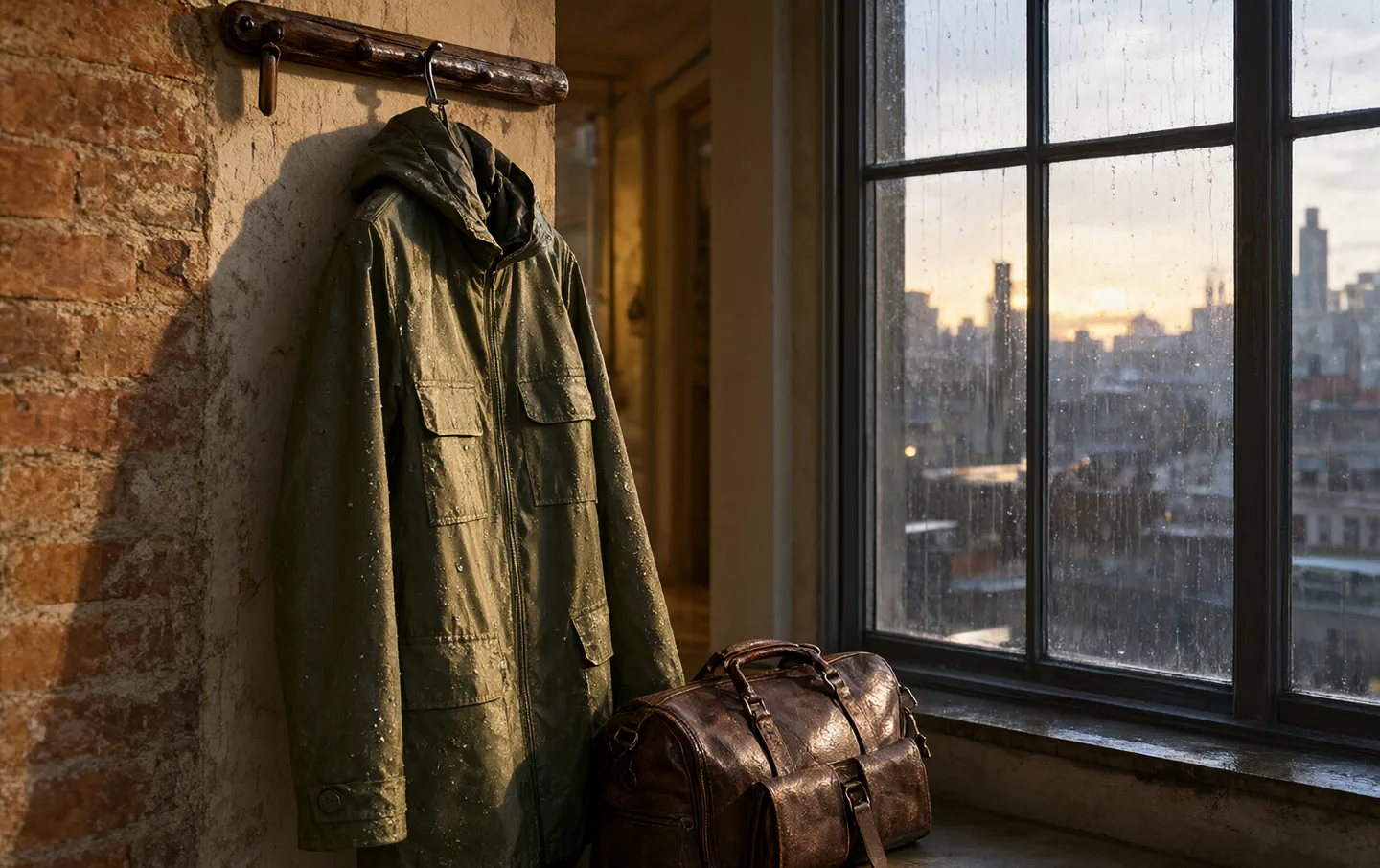
Most rain jackets are designed for a mountain and sold to a city. That is why so many have a hood built for a helmet, a hem that stops at the hip, and a fabric that sounds like a crisp packet.
A city jacket has different jobs. It has to cover a bag, survive a crowded bus, and look normal enough to wear into an office. It also has to keep rain out without turning into a sauna.
The short version#
Rains makes the best pure city jacket if you accept that it does not breathe. Stutterheim is the same idea with better materials and a much higher price. The Patagonia Torrentshell 3L is the one for actual weather, the Marmot PreCip Eco is the packable value pick, and the Uniqlo Blocktech is for drizzle and looking tidy.
Five jackets, two philosophies#
Rains Jacket
Best for commuting and looking unbothered
Rains turned a rubber raincoat into a design object. The polyester is PU-coated and welded rather than sewn, so there are no stitch holes. It does not breathe at all, which is the trade for real waterproofing and a coat that looks like clothing.
What works
- Welded seams and a coated fabric that keeps out steady rain
- Clean, boxy cut that layers over a coat
- Hood with a small brim
- Wipes clean and dries fast
What doesn't
- Essentially no breathability
- Long sleeves and a boxy body
- Snap buttons rather than a zip
Stutterheim Stockholm Raincoat
Best for people who want weight and structure
Rubberized cotton with the weight of real outerwear and double-welded seams. It is the only jacket here that works over a suit, and the least comfortable in heat. The fit is deliberately oversized.
What works
- Rubberized cotton with a substantial, dry hand
- Double-welded seams and a standing collar
- Hood holds its shape in wind
- Ages well by design
What doesn't
- Heavy and completely unbreathable
- Very expensive for coated cotton
- Runs large and long
Patagonia Torrentshell 3L
Best for people who walk a lot in real rain
A three-layer shell with a membrane, pit zips and a hood that fits over a cap. It keeps out weather and lets some vapour through. It also rustles, sits short, and looks like hiking gear over a blazer.
What works
- Three-layer construction with a waterproof membrane
- Pit zips that work on a warm day
- Hood adjusts and fits over a cap
- Repairs and resale support
What doesn't
- Crinkly fabric and a technical look
- Short, boxy cut
- Needs re-proofing eventually
Marmot PreCip Eco
Best for a jacket that lives in a bag
The jacket that lives in a tote and gets forgotten until it rains. It packs into its own pocket and keeps out a shower. The two-and-a-half-layer coating does not breathe like the Patagonia, and the thin face fabric wears under a strap.
What works
- Packs into its own pocket
- Light enough to carry daily
- Pit zips at this price
- Recycled face fabric
What doesn't
- Two-and-a-half-layer coating feels clammy
- Less durable than a three-layer shell
- Short, boxy fit
Uniqlo Blocktech Parka
Best for light rain and looking normal
A laminated parka that blocks wind and drizzle and looks like a normal coat. The seams are not fully taped on every version, and the soft hood collapses in wind. Fine for a ten-minute walk, not a wet day out.
What works
- Clean, untechnical styling
- Laminated fabric blocks wind and light rain
- Cheap enough to keep by the door
- Good length for a city coat
What doesn't
- Not fully waterproof; seams are the weak point
- Little breathability
- Soft hood flaps in wind
What the construction actually means#
A coated jacket, like the Rains, is a solid film bonded to a fabric. It is genuinely waterproof, cheap to make, and holds sweat against your back. A two-and-a-half-layer jacket has a thin membrane protected by a printed or sprayed lining; it packs small and feels clammy against bare arms. A three-layer jacket bonds the membrane to both a face fabric and a backer, so it drapes better, breathes more, and costs more.
More layers is not automatically better for a city. A heavy three-layer shell is overkill for a twenty-minute commute and unpleasant over a suit. A coated jacket is the right answer if you prioritise appearance and dry shoulders over breathability. Decide which discomfort you can live with before comparing prices.
Waterproof is a number, not a feeling#
Fabrics are rated in millimetres of water column. Around 5,000mm resists light rain; 10,000mm to 20,000mm handles sustained rain and wind. A high rating with untaped seams will still leak.
Breathability is rated separately, and the numbers are not comparable between brands. What matters in a city is whether the jacket has vents and whether the coating is a solid film or a membrane. A solid PU coating keeps water out and sweat in.
The PFAS question#
Water-repellent finishes have traditionally used fluorinated compounds, and regulators in Europe and parts of the United States have been restricting them. Brands have been reformulating, and PFAS-free finishes usually need re-proofing sooner.
Check the current product page rather than a review from three years ago. A spray-on reproofer restores beading when it fades.
What to check before you pay#
Seams. Look inside the shoulder and hood. Taped seams have a visible strip bonded over the stitching. Sewn seams with no tape will leak.
The hood. It should have a brim you can stiffen, a drawcord at the back, and enough depth to cover your head without pulling the collar off your neck.
Length. A city jacket should cover the top of a bag and the seat of your trousers.
Questions people ask#
Is a waterproof jacket worth it for a city?#
If you walk or cycle regularly, yes. If your rain exposure is a dash from a car to a door, a water-resistant coat is enough and looks better.
Why do I get sweaty inside a rain jacket?#
Because it is doing its job too well. A solid coating keeps water out and vapour in. Pit zips, a membrane and fewer layers underneath all help.
Can I wash a rain jacket?#
Yes, and you should. Dirt and body oils clog the fabric and reduce breathability. Use a technical wash without softener, rinse twice, and tumble on low if the label allows.
Are pit zips worth paying for?#
If you run warm or carry a bag, yes. They are the cheapest way to dump heat without adding a fragile membrane. A jacket with pit zips and a modest waterproof rating is often more comfortable in a city than a higher-rated shell without them.
The right city rain jacket is the one you actually carry. A perfect shell that stays home because it is too technical is worse than a cheap coat you wear without thinking.