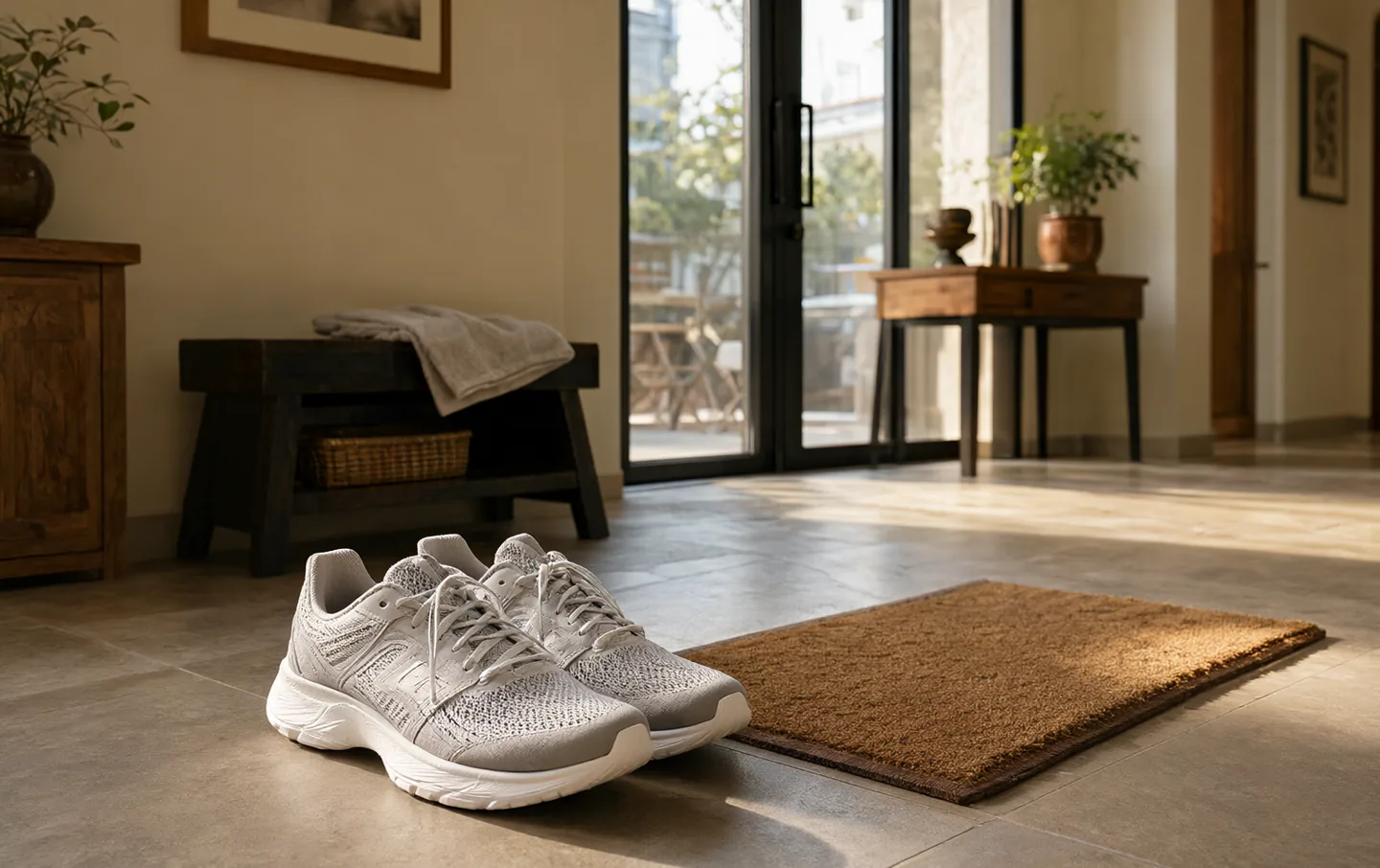
Most running shoe advice is written for people who already run. It talks about tempo, cadence and race day, and assumes you know what a neutral trainer is. If you are buying a first pair to walk and jog a little, most of that is noise.
The useful questions are simpler: does it feel comfortable, is there room for your toes, and does the heel stay put? Answer those and you are most of the way there.
The short version#
Brooks Ghost 18 is the safest first pair: comfortable and available in wide sizes. Hoka Clifton 11 is the soft, rockered option. Asics Novablast 6 is the bouncy one, On Cloudsurfer 2 the smooth-rolling one, and Saucony Ride 19 the dependable all-rounder.
Five current trainers#
Brooks Ghost 18
Best for a neutral everyday shoe
The Ghost is the shoe running shops hand to people who do not know what they want, which is a compliment. A neutral daily trainer with a comfortable upper and sensible cushioning, it absorbs a jog around the park and a walk to the shop equally well. Newer foams have made it feel old-fashioned, and it is not a shoe for dinner.
What works
- Comfortable straight out of the box
- Wide and extra-wide sizes widely available
- Predictable, stable ride for new runners
- Durable outsole for pavement
What doesn't
- Heavy compared with newer foams
- Looks like a running shoe, not a lifestyle shoe
- Cushioning is pleasant rather than exciting
Hoka Clifton 11
Best for people who want maximum comfort
The Clifton made thick, soft midsoles normal. A tall stack of soft foam sits under a light upper, with a rocker that rolls you from heel to toe. For a new runner that is forgiving, and it takes the edge off pavement on longer walks.
The trade is stability: the platform feels vague on gravel or a cambered path. The wide version is a genuine wide rather than a token one, and this is the pair here most likely to end up as a walking shoe.
What works
- Soft, generously cushioned ride
- Rocker shape helps the foot roll through
- Light for the amount of foam
- Wide fit available
What doesn't
- Less ground feel, which some people dislike
- Rocker can feel unstable on uneven ground
- Outsole durability is only average
Asics Novablast 6
Best for people who want a livelier ride
The Novablast has always been the fun shoe in Asics' range, and the sixth version adds a firmer forefoot foam for more response. It has an 8mm drop and a light mesh upper. The bounce makes an easy jog feel like play, which matters if motivation is the problem.
At slow speeds on rough ground it feels less planted than a conventional trainer, and it runs long. Check the heel with the socks you actually run in.
What works
- Energetic, bouncy foam
- Light for its stack height
- Comfortable engineered mesh upper
- Good grip on wet pavement
What doesn't
- Less stable at slow speeds
- Fits long; some people size down
- The bounce is not for everyone
On Cloudsurfer 2
Best for a quiet, smooth ride
On's Cloudsurfer is the brand's comfort shoe and the smoothest ride here. A rocker geometry rolls through the stride quietly, without the bounce of the Novablast or the softness of the Clifton.
The upper is well finished, and the shoe looks less like gym equipment than most, which makes it the easiest pair to wear for a jog and a coffee afterwards. The outsole rubber is not the most durable, and you pay a premium for the design.
What works
- Very smooth heel-to-toe transition
- Comfortable, well-finished upper
- Looks good enough for everyday wear
- Softer than earlier On models
What doesn't
- Expensive for the materials
- Outsole wears faster than the competition
- Not much ground feel
Saucony Ride 19
Best for an unfussy daily trainer
The Ride does everything competently and nothing dramatically. A moderate stack of PWRRUN foam, a conventional 8mm drop and a fit that suits most feet add up to a pair you forget you are wearing.
It feels firmer and more grounded than the Clifton or the Novablast, which suits people who walk a lot in their running shoes. It is rarely exciting and often discounted once a new version lands.
What works
- Balanced cushioning that suits most runners
- Firmer and more stable than the soft options
- Comfortable upper with a secure heel
- Often discounted
What doesn't
- Nothing about it is memorable
- Less plush than the Clifton
- Limited colour choices in some markets
Fit beats theory#
The best predictor of whether a shoe works is comfort, not a gait chart. Try shoes late in the day, when feet are slightly swollen, with the socks you run in. There should be a thumb's width between your longest toe and the end, no pressure across the top, and no heel lift when you walk. The widest part of your foot should sit at the widest part of the shoe.
If you have pain, a history of injury or a diagnosed condition, see a physiotherapist rather than self-diagnosing from an online quiz.
What heel drop changes#
Heel drop is the height difference between heel and forefoot. Most everyday trainers sit around 8 to 12mm. A higher drop feels familiar to people who wear ordinary shoes and loads the calf and Achilles less; a lower drop asks more of those tissues. There is no correct number. A new runner is usually best in the conventional range, and a lower drop is worth trying gradually rather than overnight.
When to replace them#
Most everyday trainers last roughly 500 to 800 kilometres, depending on weight, surface and stride. The outsole may still look fine when the foam has compressed, so go by feel: if the shoe feels flat, or you notice aches you did not have before, it is done. Rotating two pairs lets the foam recover and extends the life of both.
Questions people ask#
Do I need a gait analysis?#
Not necessarily. A comfort-based choice works for most new runners. Gait analysis can help with a specific concern, but it is not a diagnosis, and the recommendation often depends on who is doing it.
How do I know if a running shoe fits?#
A thumb's width at the toe, no pressure across the top, no heel slip when you walk, and no spilling over the sole at the widest point. Try them with running socks at the end of the day.
Can I use running shoes for walking and the gym?#
Yes for walking and light gym work. Running shoes are built for forward motion, so they are not ideal for heavy lifting or lateral movement. A dedicated trainer is better for the gym.
The right first pair is the one comfortable enough to wear again tomorrow. Everything else can be adjusted later.