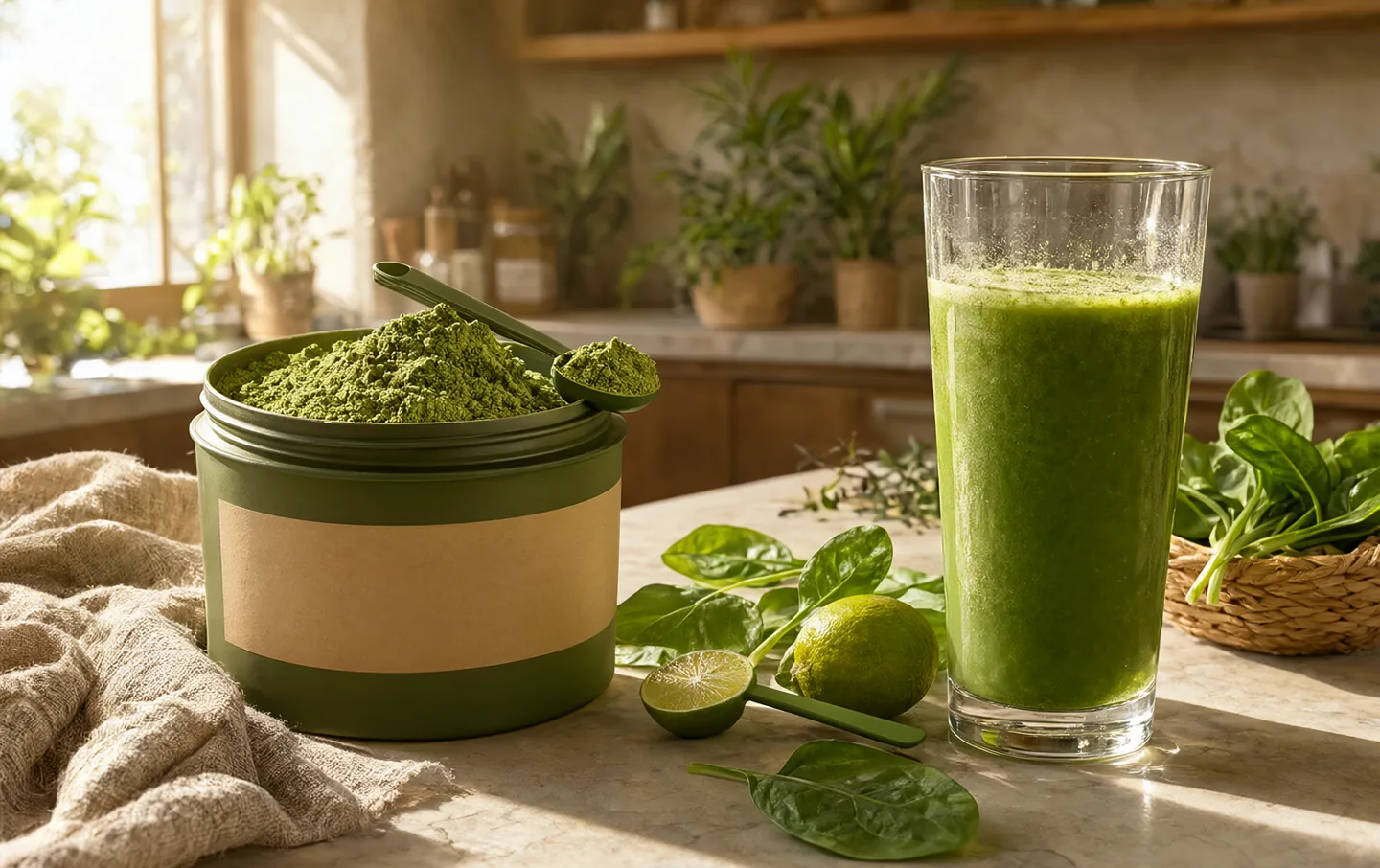
Greens powders are sold as a shortcut to a serving of vegetables, a cleaner morning, and sometimes a vaguer sense of virtue. The ingredients are mostly dried plants, sometimes with fiber, probiotics, and vitamins. That is not nothing. It is also not a salad.
The category is expensive and lightly regulated. Many products use proprietary blends, which means the label tells you what is in the scoop but not how much of each ingredient. The front of the tub is marketing; the back is the only part worth reading.
We are not going to pretend a powder can replace food. The useful question is whether it is a convenient supplement you will actually use, or an expensive jar of dried parsley.
The short version#
AG1 is the tested, expensive option with a sport certification. Bloom is the cheaper, sweeter scoop. Naked Greens is for people who want no added sweeteners. Live It Up Super Greens is organic and stevia-free, but a recall means checking the lot before you buy.
The short list#
AG1
Best for one scoop with a sport certification
AG1 mixes 75 ingredients into a 12 g serving, including dried greens, probiotics, and adaptogens. It has 40 calories, 6 g of carbs, and 2 g of protein. It carries NSF Certified for Sport, which is unusual in this category and meaningful if you are drug-tested.
The formula is a proprietary blend, so you cannot tell how much of each ingredient you get. The taste is earthy, the subscription is the main way to buy it, and the price is the highest here. It is convenient, not a replacement for vegetables.
Buy it if you want one tested scoop and the cost does not bother you. Do not buy it if you want to know the dose of every ingredient.
What works
- NSF Certified for Sport
- 75 ingredients
- 12 g serving
- Convenient single scoop
What doesn't
- Proprietary blends
- Very expensive
- Subscription model
- Earthy taste
Bloom Greens
Best for a cheaper, sweeter daily drink
Bloom is a flavored greens powder with more than 30 ingredients, a scoop per serving, and about 2 g of fiber. It is sweetened with stevia and mixes into water more easily than the earthy brands. The price per serving is much lower than AG1.
The blends hide the doses, the probiotic dose is low at 2.5 billion CFU, and the product does not carry a sport certification. The sweetness is a matter of taste; some people find it artificial. It is a supplement, not a vegetable.
Buy it if you want a cheap, drinkable habit and understand what you are getting. Do not buy it if you want a transparent label.
What works
- Low cost per serving
- Easy to drink
- About 2 g fiber
- Widely available
What doesn't
- Proprietary blends
- Sweetened with stevia
- Probiotic dose is low at 2.5 billion CFU
- No sport certification
Naked Greens
Best for people who dislike stevia
Naked Greens is sold as an unsweetened greens blend. The label is shorter than most in this category, and the company says it tests for heavy metals and contaminants. The taste is grassy and bitter, which is what unsweetened greens usually taste like.
Even a shorter blend is still a blend, so the individual doses are not clear. It does not carry a sport certification, and the powder does not dissolve completely. If you need sweetness to drink your greens, this is not the one.
Buy it if you want an unsweetened, plant-based option. Do not buy it if you want a pleasant drink.
What works
- Plant-based greens blend
- No added sweeteners
- Heavy-metal testing claimed
- Shorter label than most
What doesn't
- Bitter, grassy taste
- Still a proprietary blend
- No sport certification
- Does not dissolve completely
Live It Up Super Greens
Best for organic greens, if the lot is clear
Live It Up Super Greens is an organic blend with no stevia, sold in a 30-serving tub. It is third-party tested and made in a GMP facility. It is also the subject of a recall: several lots, including tubs with expiration dates more than a year out, were pulled after being linked to a Salmonella outbreak.
The recall is the important part. A product can be organic and still be contaminated, and a certificate does not cover every batch forever. Check the FDA notice and the expiration date on the tub; do not use a lot that falls in the recalled range. The formula is proprietary, the taste is divisive, and it is sold mainly online.
Buy it only if you can confirm the lot is clear. Do not buy it because "organic" feels safer.
What works
- Organic ingredients
- No stevia
- Third-party tested
- 30 servings
What doesn't
- Recalled lots over Salmonella
- Proprietary blends
- Divisive taste
- Sold mainly online
A scoop of powder is not a serving of vegetables#
Fiber is the first number to check. A serving of vegetables brings fiber, water, and volume. Most greens powders bring 1–3 g of fiber, if that. If the tub does not list fiber, assume it is low and do not count the scoop toward your daily vegetables.
Vitamins may be added, not grown. Some powders are fortified with synthetic vitamins to make the label look impressive. That is not necessarily bad, but it is different from eating plants. Check the %DV column and compare it with the ingredient list.
Proprietary blends hide the dose. A blend can list 5 g of "greens blend" without telling you how much spinach, spirulina, or parsley is in it. That makes it impossible to compare with a studied dose or with another product. A transparent label is worth paying for.
Probiotics in a powder are a question mark. The CFU count may be at manufacture, and the powder may sit in a cupboard for months. If the label does not state a count through expiry, consider the probiotic claim a bonus rather than a reason to buy.
Heavy metals are a real category risk. Leafy greens, rice, and cocoa can carry cadmium or lead from the soil. Testing matters. Look for a named program or published results, not just the word "tested."
Microbial contamination is the other risk. Powders are not sterile, and a recall can happen to an organic brand with a testing program. Check recall notices and lot numbers, and follow the storage instructions. A testing seal covers a batch, not every tub.
Ignore cleansing claims. Your liver and kidneys do the work. No powder flushes them, and a product that promises to "cleanse" is telling you more about its marketing than its ingredients. The category is lightly regulated, and "natural" does not mean risk-free.
Questions people actually ask#
Can greens powder replace vegetables?#
No. It lacks the fiber, water, and volume of whole vegetables, and the doses of individual plants are usually small. It can be a convenient supplement, not a substitute for food.
Do greens powders cleanse your body?#
No. Your liver and kidneys handle that. Claims about cleansing or flushing are marketing, not a physiological service a powder can provide.
Are expensive greens powders better?#
Not necessarily. Price buys packaging, certification, and marketing as well as ingredients. Compare the fiber, the vitamin doses, and the testing seal before you compare the price.
A greens powder is a habit product. If it helps you drink something green in the morning and you can afford it, that is a legitimate reason to buy one. Just do not confuse the habit with the vegetables.