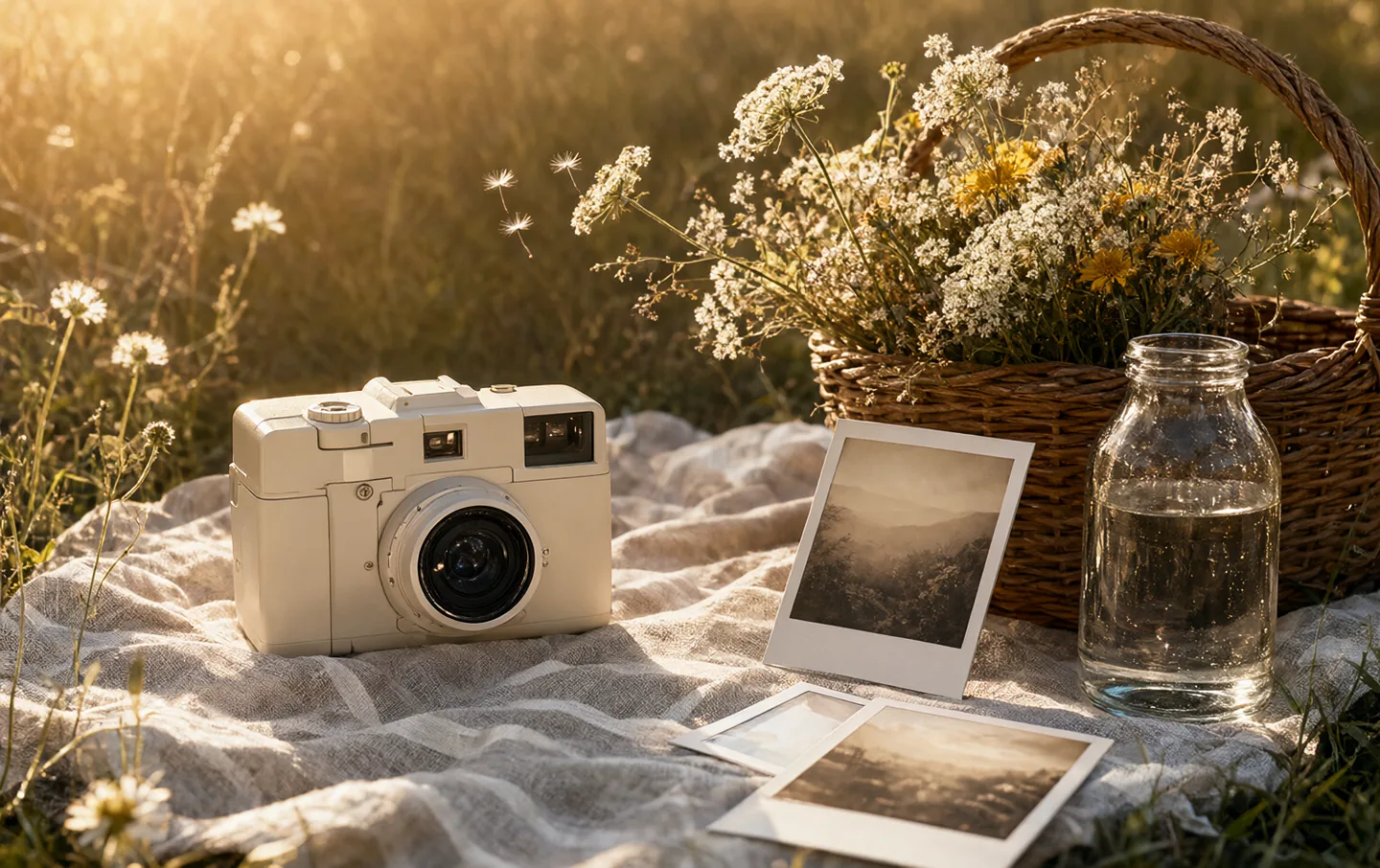
The photos on your phone are for remembering. An instant print is for giving away, sticking to a fridge, or leaving in a book. That is the whole transaction: you press a button, a small physical object comes out, and you hand it to someone. If that sounds like a gimmick, you will not use one.
The camera is the cheap part. Film is the real purchase, and the format you choose decides how much each memory costs. We looked at print sizes, film prices, exposure behavior, and the cameras that are small enough to end up in a bag.
The quick version#
The Instax Mini 13 is the one most people should buy: small, simple, and cheap per print. The Mini Evo is for someone who wants to choose the shot before printing it. The Wide 400 is for group photos and landscapes. The Polaroid Now+ Gen 3 makes the biggest, moodiest prints, at the highest cost per frame.
The short list#
Fujifilm Instax Mini 13
Best for parties, travel, and photos that end up in a wallet
The Mini 13 is the current version of the camera everyone hands to a friend at a birthday. Twist the lens to turn it on, choose close-up or normal, and press the shutter. The new self-timer is the main upgrade over the Mini 12, which is still around for less money if you find one.
The prints are small: 86 by 54mm, with an image area of 62 by 46mm. That is enough for a face or a detail, not a landscape. The flash is automatic and always ready, which helps indoors and can flatten a portrait in bright sun. There is no way to override it.
The film is the reason to choose Mini. A pack of ten costs roughly what two coffees cost, and the camera itself is cheap enough to take anywhere. If you want the instant camera people actually carry, this is it.
What works
- Pocketable and light
- Cheapest film of the group
- New self-timer for group shots
- Runs on AA batteries
What doesn't
- Prints are business-card small
- Flash fires whether you want it or not
- No manual exposure control
- Plastic body feels disposable
Fujifilm Instax Mini Evo
Best for people who want to choose the shot before they print
The Mini Evo is a hybrid: a small digital camera with an instant printer inside. You compose on a screen, apply one of the lens or film effects with the dials, and print only the frames you like. That last part is the appeal. With an analog Instax, every experiment costs a print.
The camera is more fun to hold than to use as a camera. The sensor is small, low light is noisy, and the autofocus is leisurely. The prints have the Instax look, and printing a photo from your phone works well enough for a party. The app is the weak link, as it is on most camera apps.
Buy it if the choice matters more than the ritual. If you want the sound of the shutter and the surprise of a print, buy the cheaper analog camera and waste a few frames.
What works
- Screen lets you review before printing
- Ten lens and ten film effects
- Can print photos from your phone
- USB-C charging and a retro body
What doesn't
- It is a digital camera with a printer attached
- Image quality is phone-from-years-ago
- App is clunky
- Prints still cost the same
Fujifilm Instax Wide 400
Best for weddings, camping, and landscapes
The Wide 400 makes prints that feel like small photographs rather than receipts. The image area is 62 by 99mm, roughly twice the Mini, which means a group of five can fit without someone being cropped out. It is the camera for a picnic table, a tent, or a view.
It is also the least portable camera here. At around 616g before batteries and film, it needs a bag of its own. The controls are minimal: normal or landscape focus, a self-timer lever, and a close-up lens that clips on for shots at 40 to 50cm.
If you mostly photograph people at arm's length, the Mini is easier. If you want the print to hold a place as well as a face, the Wide is worth the bulk.
What works
- Wide prints hold a whole group
- Simple point-and-shoot operation
- Self-timer with four settings
- Close-up lens included
What doesn't
- Bulky and heavy for a casual bag
- Film costs more than Mini
- Fixed flash and limited exposure control
- Close-up lens is easy to lose
Polaroid Now+ Gen 3
Best for portraits, moody color, and photos that go on a wall
Polaroid prints are bigger, softer, and more atmospheric than Instax. The Now+ Gen 3 is the modern version of the classic box, with autofocus, a built-in flash, and app-controlled modes for double exposure, light painting, and aperture priority. It is the camera for someone who wants the print to look like a memory rather than a record.
It is also the most demanding. Polaroid film is sensitive to temperature and light, and the camera rewards shade and steady hands. In bright sun, the highlights can blow out; in cold weather, the colors shift. A print takes around 15 minutes to develop.
The film cost is the barrier. A Polaroid print costs more than twice what an Instax Mini print does, so every shot is a decision. If you want to take a hundred photos at a party, this is the wrong camera. If you want one good portrait for a shelf, it is the right one.
What works
- Largest prints of the group
- Creative modes through the app
- Tripod mount and USB-C charging
- Distinctive soft, warm look
What doesn't
- Film is the most expensive here
- Exposure is fussy in bright sun
- Development takes around 15 minutes
- App is needed for the creative modes
Choose the print, then the camera#
Instax Mini is the wallet format: small, cheap, and easy to give away. It is the best format for parties and travel because you can afford to take a few bad shots.
Instax Wide is the group and landscape format. The prints are twice the size of Mini and feel more like photographs. The cameras are bigger, and the film costs more.
Polaroid i-Type is the biggest and most expensive. The color is warmer and less predictable, and the prints have a softness that people either love or find frustrating. It is the least economical way to take a lot of photos.
Hybrid cameras such as the Mini Evo let you review and print from your phone. They are more flexible and less magical.
Exposure is the thing nobody warns you about#
Instant cameras like light, but not the wrong kind. Most have a fixed flash that fires within a certain range, usually about 1 to 3m. Stand closer than that and faces go white; stand farther and the flash does nothing.
In bright sun, look for shade or turn so the sun is behind you. Polaroid film is particularly easy to overexpose. Instax handles daylight better but still struggles with high-contrast scenes.
Close-up mode is not optional. Every camera here has a minimum focus distance, and ignoring it produces a blurry print. On the Mini 13, twist the lens to the close-up setting for anything under half a meter.
Questions people actually ask#
Which instant film is cheapest?#
Instax Mini is the cheapest per print, followed by Instax Wide, with Polaroid i-Type the most expensive. The camera prices are similar; the film is where the format decision shows up over a year.
Can I use an instant camera as a printer?#
Only hybrid models such as the Mini Evo, the Instax LiPlay, or the Wide Evo can print from your phone. The analog cameras here cannot receive a digital file. If printing phone photos is the main goal, buy a hybrid.
Why are my prints dark or blurry?#
Usually distance and light. The flash has a limited range, close-up mode was not selected, or the camera moved during a slow exposure. Polaroid film also needs more light than Instax. Check the minimum focus distance before you blame the camera.
An instant camera is a small, expensive, slightly unpredictable printer that happens to take photos. Buy it for the object, not the image quality, and choose the film size you will actually use.