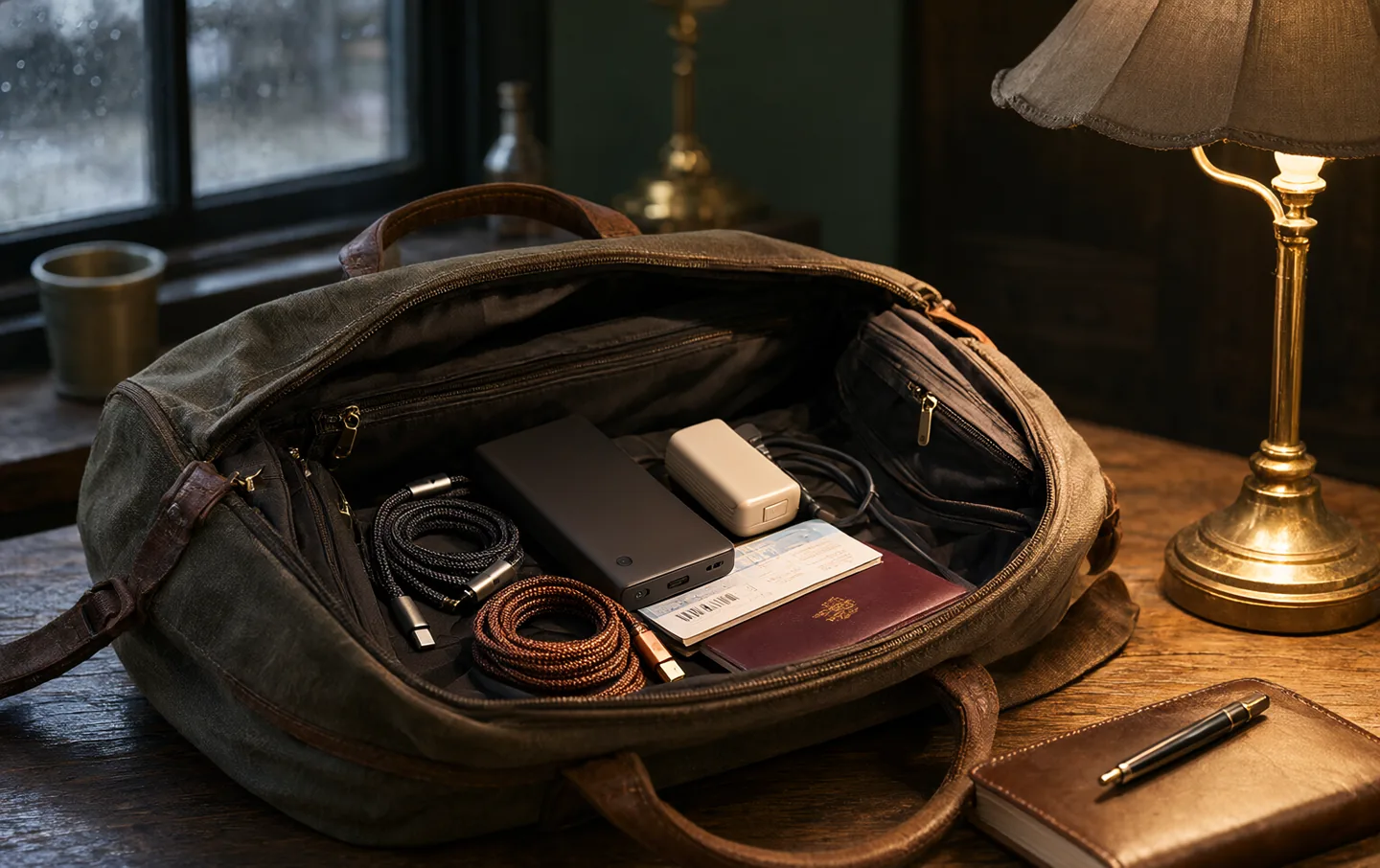
The number printed largest on a power bank is the least useful one. Milliamp-hours tell you how much charge the cells hold in theory; watt-hours tell you what an airline will allow and roughly how much work the pack can do. A travel power bank is a weight budget as much as a battery, and the best one is the lightest pack that covers your worst day.
We read the airline rules, compared rated energy against real device batteries, and looked at the complaints that show up after a year of travel: ports that loosen, displays that lie, packs that charge slowly while also discharging. No laboratory, no pretend airport tests.
The quick version#
The Anker Prime 20K is the one to carry if you travel with a laptop. The Nitecore NB10000 Gen 4 is the pack for people who count grams. The Anker Nano 10K is the small everyday pack that lives in a tote. And the Sharge Shargeek 300 is for camera gear and two-laptop trips, if you can live with the weight.
The short list#
Anker Prime Power Bank (20K, 220W)
Best for travellers with a laptop and a phone
This is the pack to buy when one charger has to cover a work trip. The 20,000mAh cells work out to roughly 72Wh, comfortably under the 100Wh carry-on limit, and the output is high enough to charge a 14-inch laptop at a useful speed rather than a trickle.
The screen is genuinely helpful at an airport: it shows the percentage left and how much power is going out, so you can tell whether the cable or the device is the problem.
The cost is weight. It is a pocket pack in the way a paperback is a pocket book: technically, if the pocket is large. For a commute or a day bag, the smaller Anker below is the better companion.
What works
- 220W total output charges a laptop quickly
- Rated around 72Wh, so it flies without approval
- Screen shows remaining charge and wattage
- Two USB-C ports plus USB-A
What doesn't
- Heavy enough to notice in a small bag
- Overkill if you only charge a phone
- Display and app add complexity you may never use
Nitecore NB10000 Gen 4
Best for hikers, runners, and anyone with a small bag
Nitecore's pack is a small carbon-fiber slab that weighs less than the phone it charges. The fourth generation shaved a few grams and added IPX7 water resistance, which is more useful on a trail than a screen full of statistics. It is the pack you forget is in the bag until you need it.
The trade is speed and capacity. At 22.5W it will charge a phone at a reasonable pace and a tablet slowly; a laptop is a courtesy charge, not a working session. The capacity is enough for roughly two phone top-ups, not a weekend off the grid.
The tap-to-wake light is a solution to a problem most people do not have, and it does not always register. Ignore it. The weight and the water resistance are the reasons to pay.
What works
- About 143g, lighter than most phones
- IPX7 water resistance
- Rated around 39Wh, welcome on any airline
- Enough for two phone charges in a pinch
What doesn't
- 22.5W output is slow for tablets and laptops
- No display, just a light
- Tap-to-wake can be temperamental
- Expensive for the capacity
Anker Nano Power Bank (10K, 30W)
Best for a tote, a jacket pocket, and short trips
The Nano is the pack that solves the actual daily problem: your phone is at 12 percent and you are nowhere near an outlet. The USB-C plug folds out of the body, so there is no cable to untangle, and 30W gets a phone back to useful in half an hour.
It is not a travel workhorse. The capacity is one phone charge with a little left over, and the built-in connector means you cannot easily charge two things at once. A thick phone case may stop the plug from seating fully; take the case off.
For the price, it is the pack to leave in a bag and stop thinking about. If you already carry a cable and a bigger pack, you probably do not need it.
What works
- Built-in USB-C connector, no cable to lose
- Small enough to carry without thinking
- 30W is quick for a phone
- Cheap enough to own two
What doesn't
- One device at a time
- Built-in connector can be awkward with thick cases
- No display or app
- Not enough for a laptop
Sharge Shargeek 300
Best for camera kits, drone trips, and two-laptop days
The Shargeek 300 is for the trip where the bag already contains a camera, a laptop, and a handful of batteries. The DC output can be set to the voltage a camera or light expects, and the two USB-C ports can each deliver enough for a large laptop. The 86.4Wh rating keeps it on the right side of airline rules.
It is not a general-purpose travel pack. At around 750g it is heavier than some laptops, and the transparent shell with colored lighting is a look rather than a feature. The screen is useful, but the app and the DC dial are things you have to want to use.
Buy it if you already carry gear that needs a specific voltage. Otherwise, the Anker Prime is lighter, cheaper, and simpler for the same kind of trip.
What works
- 300W total output with an adjustable DC port
- Rated 86.4Wh, under the airline limit
- Clear screen for watts and battery health
- Can run cameras and lights, not just phones
What doesn't
- About 750g, a brick in a backpack
- Overkill and expensive for phone charging
- Transparent case and RGB lighting are an acquired taste
- The DC port is a niche feature
Watt-hours, not milliamp-hours#
The formula is simple: watt-hours = milliamp-hours × voltage ÷ 1,000. Most power banks use cells rated around 3.6 to 3.7 volts, so a 10,000mAh pack is roughly 36 to 37Wh, a 20,000mAh pack is roughly 72 to 74Wh, and a 27,000mAh pack lands near 100Wh.
Airlines generally allow packs up to 100Wh in carry-on without approval. Between 100Wh and 160Wh, you need the airline's approval and usually a limit of two packs. Above 160Wh, they are not allowed in the cabin. Spare packs must stay in the cabin, not in checked luggage, and a damaged or unlabeled pack can be refused even if the number is fine.
Output, pass-through, and cables#
Output matters more than capacity for laptops. A 20,000mAh pack with a 30W port will charge a laptop slowly, and may not charge it at all while it is running. Look for 45W or more per port if a laptop is part of the plan.
Pass-through charging lets the pack charge itself and a device at the same time. It is convenient at a hotel with one outlet, but it is slower and generates more heat than charging separately.
Cables are half the purchase. A thin cable that came free with a phone may cap charging at 15W. A USB-C cable rated for 100W or more is worth the extra few dollars, and a short one is less likely to snag in a bag.
Capacity is not the same as usable energy. Conversion losses mean a 10,000mAh pack delivers closer to 6,500 to 7,000mAh to a phone. Expect two solid phone charges, not three.
Questions people actually ask#
How many phone charges will I get?#
A 10,000mAh pack is good for roughly two charges of a modern phone, a 20,000mAh pack for four or five, depending on the phone and how warm the pack gets.
Can I take a 20,000mAh power bank on a plane?#
Usually yes. Most 20,000mAh packs are rated around 72 to 74Wh, under the 100Wh threshold. A 27,000mAh pack can sit just under 100Wh, but the margin is thin and some labels round differently, so check the printed Wh rather than the mAh.
Is fast charging bad for the battery?#
Heat is the thing that ages lithium cells, and fast charging creates more of it. A 30W phone charge is not a problem. A 140W laptop charge in a hot bag is harder on the pack. Keep it ventilated, and do not leave it on a car dashboard.
Pick the capacity for your worst normal day, check the watt-hours, and spend the rest on a cable that will not be the weak link.