Pearls have a reputation problem, and it is mostly the fault of bad pearls. A dull, perfectly round strand in a department-store box reads as something borrowed for a wedding, then returned to a drawer. A good pearl looks alive: it reflects the room, holds a little color, and makes the wearer look calmer rather than older.
The difference is not a brand name. It is luster, surface, shape, and the way the pearls are matched. Size matters last, which is the opposite of how most pearl jewelry is sold.
The short version#
Pearl Paradise is the best place to buy a classic strand with real specifications. Mejuri makes the easiest everyday freshwater piece. Monica Vinader's Nura is the one with a looser, less formal shape. Catbird is for a small, fine pearl that layers. Aurate is the solid-gold option for people who want to avoid plated clasps entirely.
Freshwater, akoya, Tahitian#
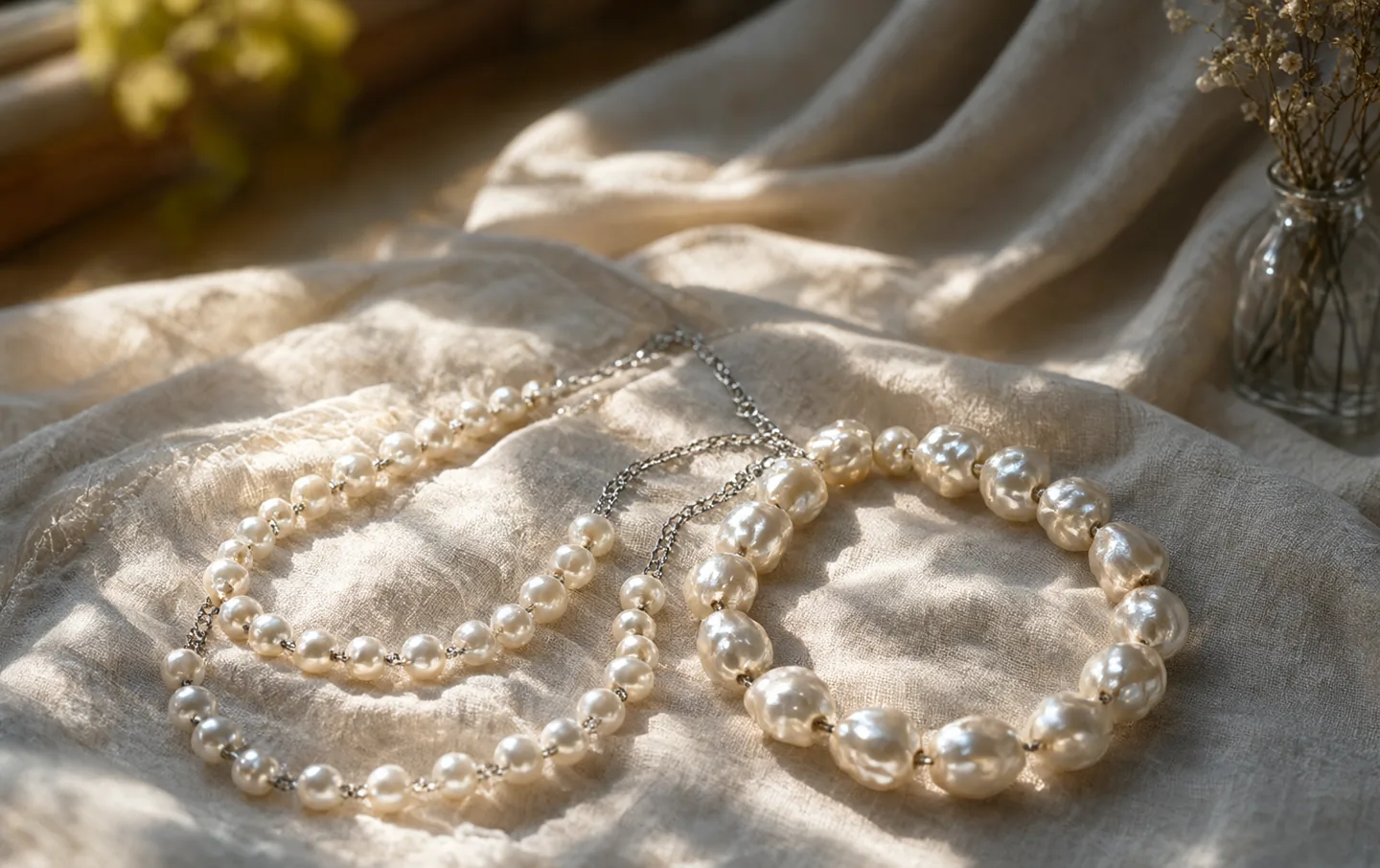
Freshwater pearls grow in mussels, mostly in China. They are solid nacre rather than a bead with a coating, and shapes range from round to potato to baroque; round ones cost more.
Akoya pearls grow in saltwater oysters, primarily Japan and China, around a bead nucleus. They are usually round, smaller (roughly 6mm to 9mm), and have a sharp, mirror-like luster. A good akoya strand is the classic formal pearl necklace, and it costs accordingly.
Tahitian pearls come from the black-lipped oyster in French Polynesia. Body colors run from silver to green to aubergine, and they are larger, often 8mm to 13mm. They are not necessarily black, and they are not dyed freshwater pearls.
South Sea pearls are the fourth category: large, expensive, and mostly relevant if you are shopping at a specialist. If a listing says "South Sea" at a freshwater price, it is not South Sea.
Luster before size#
Look at the reflection on the pearl's surface. A sharp reflection, almost like a mirror, is good. A blurry one means low luster, no matter how large or round the pearl is. Photographs can exaggerate this, so ask for a video in daylight if you are spending real money.
Surface matters next. Small blemishes are normal and often hidden by the setting. Deep pits, cracks, or chalky patches are not. Shape should be judged by the piece: perfectly round pearls are formal and expensive, while baroque pearls are more casual and hide imperfections better. Matching is the quiet skill: on a strand, the pearls should graduate smoothly and share an overtone.
Length and clasp#
Sixteen inches sits at the base of the throat, eighteen at the collarbone, twenty below it. An 18-inch strand is the most useful for everyday, and a 16-inch choker is more formal. Measure a necklace you already like rather than guessing.
The clasp is where cheap pearls reveal themselves. Look for a secure clasp in gold or silver, with a safety catch on more expensive pieces. On a fine pearl necklace, a small gold clasp is normal and preferable to a large decorative one.
The short list#
Pearl Paradise Freshwater Pearl Necklace
Best for a real pearl necklace with specifications
Pearl Paradise is a pearl specialist rather than a fashion brand, and it shows in the listing: grade, millimeter range, overtone, length, and clasp are all decisions you make deliberately. The freshwater strands are hand-knotted and can be ordered in the size and quality you actually want.
The risk is option creep. Every upgrade sounds small and adds up, and the photographs are good but not a substitute for daylight. Ask for a video of the exact strand and confirm the return policy.
What works
- Choose grade, size, and length
- Hand-knotted between pearls
- Specialist knowledge and photos
- Solid gold clasp options
What doesn't
- Photos vary by monitor
- Made-to-order pieces take time
- Easy to overspend on upgrades
Mejuri Pearl Necklace
Best for jeans, knits, and a lower-key neckline
Mejuri's pearl necklace is the piece to buy if you like the idea of pearls but not the formality. The pearls are small and slightly irregular, which makes the necklace look casual rather than inherited, and the setting is simple enough to wear with a T-shirt.
It is not a strand for people who want mirror-round akoya. The appeal is the looseness: a little warmth, a little imperfection, and a length that sits well under a collar.
What works
- Freshwater pearls with a warm luster
- Simple, modern proportions
- Easy to layer
- Good return window for unworn pieces
What doesn't
- Limited information on pearl grade
- Small pearls read as delicate rather than formal
- Not a strand for a wedding
Monica Vinader Nura Pearl Necklace
Best for an unstructured pearl look
The Nura collection is Monica Vinader at its most relaxed: freshwater pearls in less-than-perfect shapes, set in warm gold vermeil. The result looks like something you bought on a trip rather than something that came in a box with a certificate.
That is the point and the limitation. No two baroque pearls are identical, so the necklace you receive will differ slightly from the photograph. The vermeil is a coating, and the clasp will wear first.
What works
- Baroque freshwater shapes
- Warm gold vermeil setting
- Adjustable length on many styles
- Five-year warranty on craftsmanship
What doesn't
- Vermeil, not solid gold
- Baroque shapes vary between pieces
- Gold finish needs care
Catbird Pearl Necklace
Best for a small pearl in a stack
Catbird's pearl necklace is a single small pearl on a fine 14k chain, which makes it less of a pearl necklace and more of a pearl that happens to be on a necklace. That is useful: it slips into a stack of gold chains without competing, and it reads modern rather than formal.
It is not the piece to buy if you want a strand. The chain is fine, the pearl is small, and the whole thing is designed to be worn close. It is, however, a good first pearl for someone who has always found pearls a bit much.
What works
- Fine 14k chain and clasp
- Small freshwater pearl
- Layers well with gold chains
- Handmade in Brooklyn
What doesn't
- Very delicate
- Not a standalone statement
- Limited pearl size options
Aurate Pearl Necklace
Best for a pearl necklace with no plated parts
Aurate's pearl necklace is for the person who likes the look but does not want to think about plating. The chain and clasp are solid 14k, so the metal will outlast the pearls and can be repaired by any jeweler. The pearl itself is freshwater, modest in size, and chosen for a clean everyday look.
You are paying for the gold, not for rare pearls. If the pearl is the main event, spend the money at a specialist instead.
What works
- Solid 14k gold chain and clasp
- Freshwater pearls
- Simple, wearable proportions
- No vermeil maintenance
What doesn't
- Higher price for the pearl quality
- Design is understated
- Pearl matching varies
Caring for pearls#
Put pearls on last and take them off first. Perfume, hairspray, and sunscreen dull the nacre, and it cannot be polished back. Wipe them with a soft, damp cloth after wearing, then let them dry flat on a towel rather than hanging, which stretches the thread.
Store pearls away from metal that can scratch them, but not in a safe or a bank box: pearls need a little humidity and can dry out and crack in very dry storage. If you wear a strand often, have it restrung every year or two. Knotting between pearls prevents loss if the thread breaks.
Questions people actually ask#
Are freshwater pearls real pearls?#
Yes. They are cultured pearls grown in mussels, with solid nacre rather than a bead nucleus. They are generally less expensive than akoya or Tahitian pearls, but they are not imitation. Glass, plastic, and shell beads are the imitations.
How can I tell if pearls are good quality?#
Look at the sharpness of the reflection, the smoothness of the surface, and how well the pearls match. Gently rub a pearl against your front teeth: real nacre feels slightly gritty, while glass or plastic feels smooth. None of this replaces seeing them in daylight.
Can I wear pearls every day?#
Yes, with care. Avoid perfume, hairspray, and chlorine, wipe them after wearing, and store them flat. Pearls are softer than gemstones and scratch easily, so keep them away from other jewelry. A well-cared-for strand will outlast most of the clothes you wear with it.
A pearl necklace should look like it belongs to the person wearing it, not like it was borrowed for the occasion.