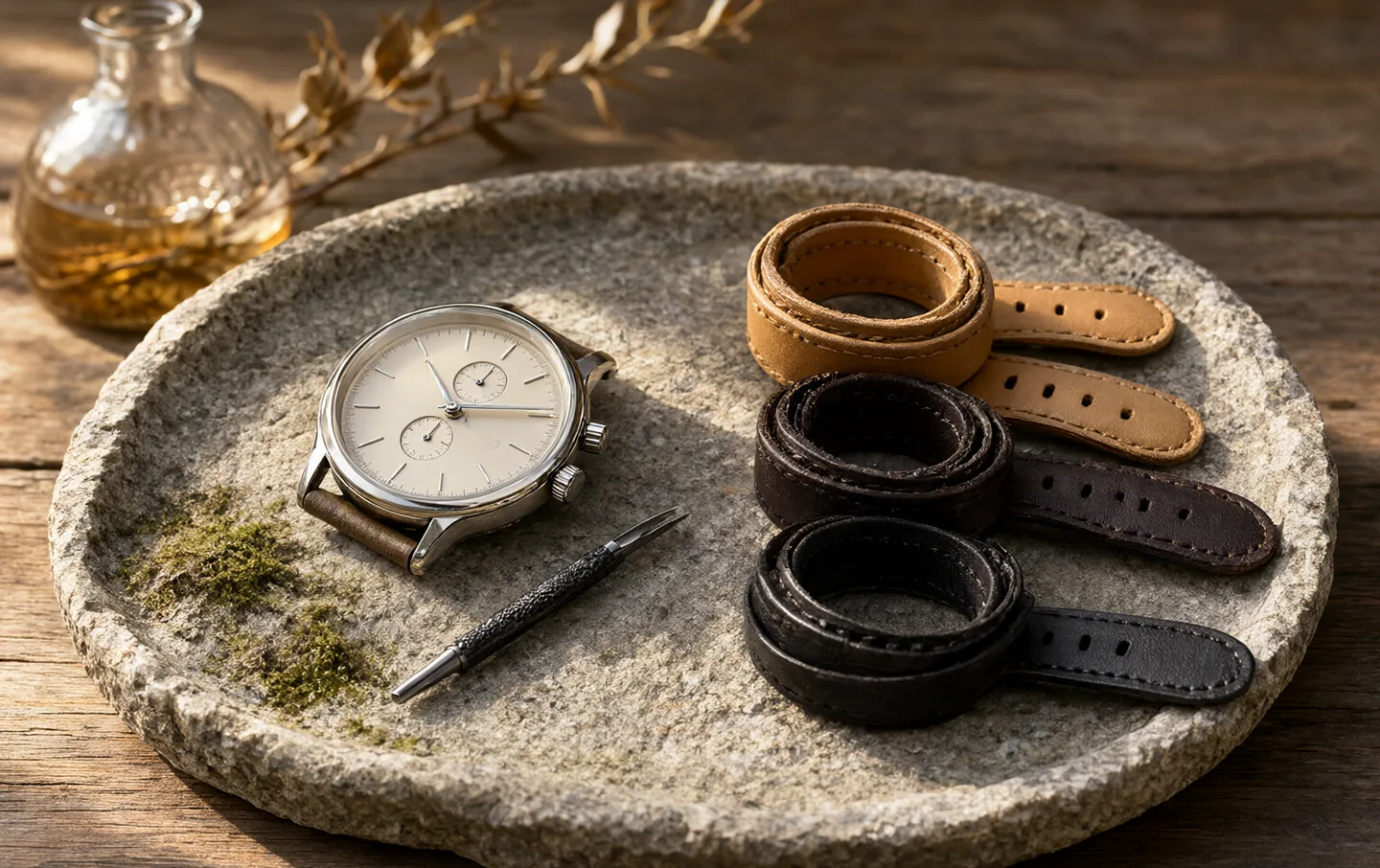
A watch is mostly a case, a dial, and a strap. The first two are fixed. The third is the cheapest way to change how the whole thing feels: $40 can make a dress watch look casual, a dive watch look wearable with a shirt, or a tired hand-me-down look like something you chose.
The catch is that straps are not universal. Lug width, spring bars, thickness, and the shape of the case all matter, and a strap that is 1mm too wide will not fit no matter how good the photograph is.
We looked at how to measure, which materials suit which watch, and four straps worth the money.
The short version#
The Hirsch Lucca is the best leather upgrade for the price. The Delugs CTS is the rubber strap to buy if you want a dive watch to feel new. The Crown & Buckle Chevron is the weekend NATO, and the Barton Elite Silicone is the cheap experiment.
Measure the lugs, then measure again#
The lug width is the distance between the two lugs, in millimeters, where the strap meets the case. It is usually 18mm, 20mm, or 22mm, with 19mm and 21mm on some watches. Use calipers, or check the case's specification; a ruler is not precise enough.
The strap's width at the lugs should match exactly. A 20mm strap on a 19mm watch will bulge; a 19mm strap on a 20mm watch will leave a gap. Taper is separate: many straps narrow by 2mm toward the buckle, which is normal and usually more comfortable.
Spring bars are the pins that hold the strap. Quick-release bars have a small lever and let you swap a strap without tools. Standard bars need a spring bar tool, and drilled lugs make removal easier. If you change straps often, quick-release is worth seeking out.
Leather, rubber, or NATO#
Leather is the default for a reason: it is quiet, it ages, and it suits almost any non-dive watch. Calf leather is the workhorse. Embossed alligator gives a dressier texture without the cost or care of real alligator. Suede and nubuck look great for a season and then absorb sweat.
Rubber is for water, heat, and repeated washing. FKM rubber is denser and more UV-resistant than basic silicone. A rubber strap on a dive watch makes sense; on a dress watch, it looks like a mistake unless the watch is already casual.
NATO straps pass under the case as one piece, so the watch is held by two layers of nylon even if one spring bar fails. The cost is height: a NATO lifts the watch off the wrist, which can make a slim case look chunky. Seatbelt-weave nylon is softer than the stiff economy stuff.
Quick-release and other small traps#
Quick-release spring bars are only as good as the strap's stitching. If the lever pulls out of a poorly made strap, you are back to a tool and a lost pin. Check that the bar is metal, not plastic.
Curved ends are made for specific cases and can look integrated, but they are not universal. Straight ends leave a small gap, which is normal. A thick strap on a thin case looks wrong; a thin strap on a thick case looks flimsy. Match the strap's thickness to the watch rather than to the trend.
The short list#
Hirsch Lucca Watch Strap
Best for dress and everyday watches
Hirsch has been making straps for long enough that the Lucca feels sorted: soft leather, a subtle alligator grain, and a taper that suits most dress watches. It is the strap to buy when the original is cracked or when you want a watch to look more considered without spending on a new case.
It is leather, so it will darken where it bends and eventually wear through at the buckle. Keep it away from water and put it on after lotion. The embossed grain is convincing at arm's length and honest up close.
What works
- Soft, supple leather
- Alligator-embossed texture
- Good range of lug widths
- Hirsch's known quality control
What doesn't
- Not water-resistant
- Embossed, not real alligator
- Light colors show sweat
Delugs CTS Rubber Strap
Best for dive watches and hot weather
Delugs made its name with straps that fit like they were made for the watch, and the CTS is the practical one: a rubber strap you trim to length instead of punching holes. The result is a clean fit with no excess tail, which matters on a small wrist.
The catch is obvious. Measure twice, cut once, and accept that the strap now belongs to you. FKM rubber is firmer than silicone and takes a few days to soften, but it handles sweat, chlorine, and sun far better.
What works
- Cut-to-size fit
- Quick-release options
- Dense FKM rubber
- Washable
What doesn't
- Cutting is permanent
- Limited color range
- Stiffer than silicone at first
Crown & Buckle Chevron Strap
Best for travel and casual wear
The Chevron is a NATO made from a smoother, denser weave than the stiff straps that come free with a watch. It sits flat, the edges do not scratch, and it survives repeated washing, which makes it the strap to leave on a travel watch.
It is still a NATO. The watch rides higher, the extra nylon can trap heat, and the look is casual by definition. On a slim dress watch it will look like a borrowed strap.
What works
- Seatbelt-weave nylon
- Soft edges
- Secure two-layer mounting
- Machine washable
What doesn't
- Adds height to the watch
- Can feel warm in summer
- Not dressy
Barton Elite Silicone Watch Strap
Best for trying a color or a casual look
Barton's Elite silicone strap is the inexpensive way to find out whether a watch wants rubber. It comes in enough widths and colors to fit almost anything, the quick-release bars make swapping easy, and it is comfortable from the first wear.
The compromises are visible up close: the silicone picks up dust, the buckle is ordinary, and it will fade faster than a good FKM strap. At this price, that is fine. Buy one, wear it for a month, and if you like the look, spend more on a Delugs or an OEM rubber strap later.
What works
- Very low price
- Quick-release spring bars
- Many color and width options
- Easy to clean
What doesn't
- Silicone attracts lint
- Hardware feels basic
- Not as UV-resistant as FKM
Sizing and fit#
Strap length is usually given as two numbers, such as 75/125mm, meaning the buckle side and the hole side. A 6.5-inch wrist generally fits a standard 75/125; larger wrists need a longer second number. If you are between holes, a strap with more holes or a cut-to-size rubber strap is easier than punching your own.
The buckle width is often 2mm narrower than the lug width, which is normal. Check that the spring bars are the right diameter for the case; 1.8mm is common, 2.0mm is heavier, and a loose bar will rattle or fail. When in doubt, buy the bars from a watch shop rather than the cheapest listing.
Questions people actually ask#
How do I find my watch's lug width?#
Measure the distance between the inside faces of the lugs with calipers, or look up the case reference. Common widths are 18mm, 20mm, and 22mm. Do not measure the old strap if it is compressed or curved; measure the watch.
Can I put a leather strap on a dive watch?#
You can, but it will not enjoy water. Leather swells, stains, and cracks when it dries repeatedly. If you swim with the watch, use rubber or NATO and keep leather for dry days.
Are expensive straps worth it?#
Up to a point. The difference between a $20 strap and an $80 strap is usually leather quality, stitching, and hardware, and you can feel it. The difference between $80 and $200 is often branding or exotic leather. Buy the fit and the material first.
A strap is the only part of a watch you are supposed to wear out. Change it before the watch starts to feel old.