Most cat trees are sold by height and carpet colour. The things that decide whether a cat uses one, and whether you resent it, are stability, perch size, and where it sits in the room. A tall tower that sways when a cat lands is a tower the cat will avoid. A beautiful one with no scratching surface is a shelf.
We looked at base dimensions, materials, platform sizes, hiding spots, and how each tree is meant to be secured. The right choice depends on your cat's age, size, and whether they want to be high or hidden.
The short version#
The Tuft + Paw Frond is the tree we would put in a living room. The Mau Cento is the design piece with a real hiding basket. The On2Pets is for people who want the look of a plant, the Catit Vesper is the sensible mid-priced option, and the Frisco is the cheap tower that does the job if you secure it.
The short list#
Tuft + Paw Frond Cat Tree
Best for small apartments and design-conscious rooms
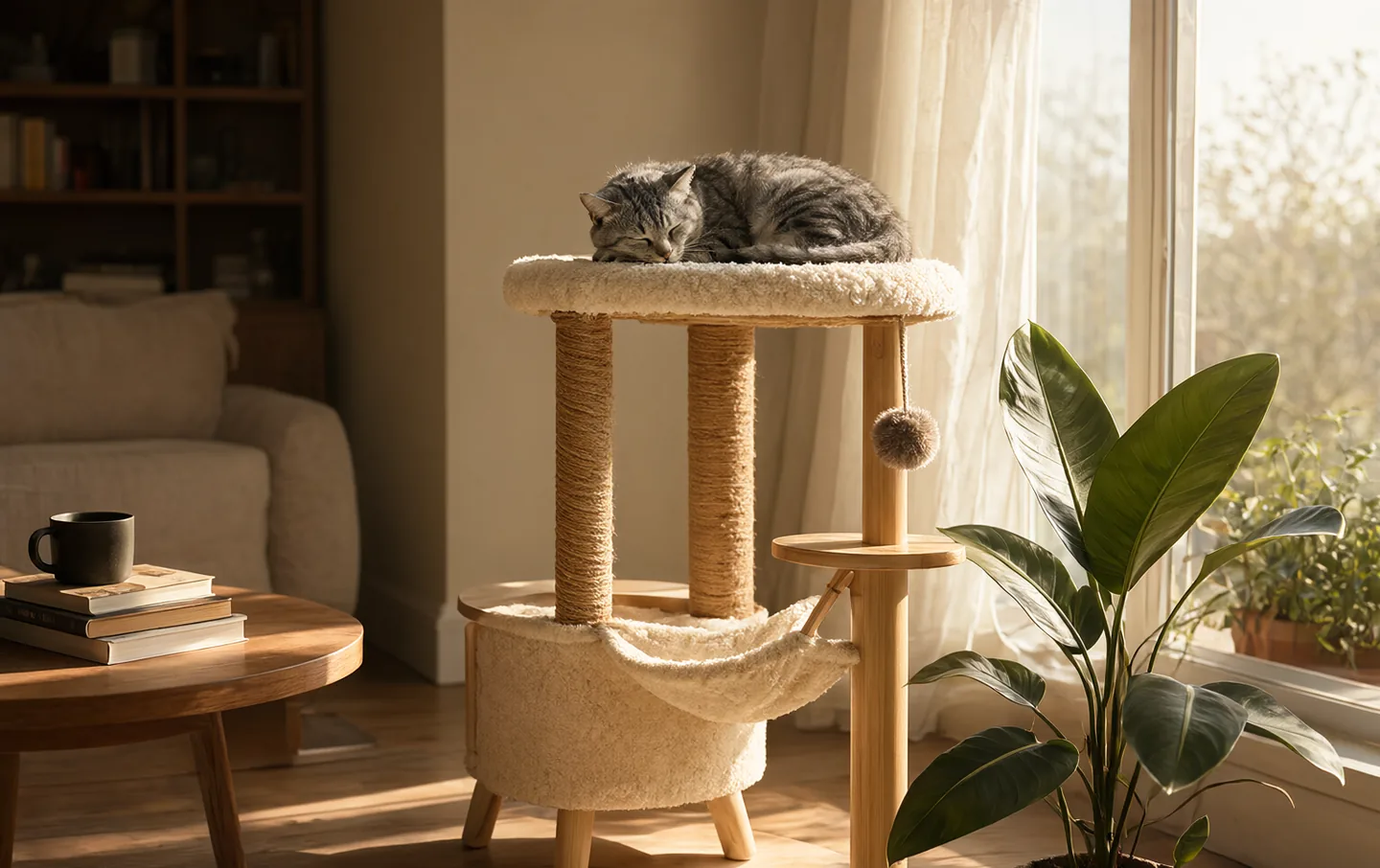
The Frond looks like a piece of furniture rather than a carpeted tower. Three ash-veneer perches rotate around a sisal-wrapped pole, so you can change the climbing route and give a cat a new view without buying anything. The base is wide for its height, and it stays put when a cat jumps.
It is about four feet tall, which is short for a cat who wants the top of the bookcase. There is no cubby, so a shy cat has nowhere to hide. The perches are generous for an average cat but tight for a Maine Coon. You are paying for materials and restraint, not for a climbing gym.
What works
- Three rotating petal perches
- Ash veneer and real sisal
- Wide 24-inch base
- Easy assembly
What doesn't
- Expensive
- No enclosed hiding spot
- One height only
- Perches suit average cats, not giants
Mau Cento Cat Tree
Best for a cat who likes a basket and a room that has to look grown-up
Mau's trees are built like furniture, with solid wood, woven baskets, and cushions that come out for washing. The Cento has a basket at the top that a cat can disappear into, plus platforms at different heights. The weight sits low, which makes it steadier than most towers at the same height.
Availability is the catch. Mau sells mainly in the US, and the price is high for a tree with limited sisal. The basket suits a small or average cat; a big cat will hang over the edge. If you want a tree that doubles as a piece of furniture and your cat likes to hide, it is worth the search.
What works
- Solid wood frame
- Woven basket hide
- Replaceable cushions
- Heavy, stable base
What doesn't
- Expensive and hard to find outside the US
- Basket is small for large cats
- Assembly takes patience
- Few scratching surfaces
On2Pets Modern Cat Tree
Best for people who want greenery without a toxic plant
On2Pets solves a specific problem: a cat tree that reads as a plant. The base looks like a patch of grass, the trunk rises about five feet, and silk leaves on PVC branches fill out the shape. The shelves are carpeted and wide enough to nap on, and the leaves can be swapped by season.
The branches are decorative, not structural. The top shelf has a little flex, and a heavy cat landing on it will notice. There is no sisal, so this is a perch and a hide, not a scratcher. Buy it for the look and the shelves, not for climbing.
What works
- Looks like a small tree
- Swappable silk leaves
- Three carpeted shelves
- Sturdy square or round base
What doesn't
- Top perch can wobble
- No sisal scratching post
- Leaves need dusting
- Cats may ignore the upper level
Catit Vesper Cat Tree
Best for a first cat tree in a normal apartment
Catit's Vesper line is the midpoint between a carpet tower and a designer tree. The finish is a wood-look laminate, the cubby is enclosed, and the posts are wrapped in sisal. It wipes clean, which matters with a cat who sheds.
The laminate is not solid wood, and a determined scratcher can chip an edge. The cushions are thin enough that a cat may prefer a blanket on top. Heights vary by model, so check the measurements rather than the photos. For the price, it is the most house-trained option here.
What works
- Modern wood-look finish
- Enclosed cubby
- Sisal posts
- Several sizes and configurations
What doesn't
- Heavy to move
- Laminate can chip
- Cushions are thin
- Some models are quite low
Frisco Cat Tree
Best for a tall tree on a budget
Frisco is the store-brand tower that shows up in a lot of homes, and for good reason: it is cheap, tall, and cats use it. The larger models have deep condos, wide perches, and enough sisal to redirect scratching. If you want height without spending $500, this is the practical answer.
Stability is the trade-off. The particleboard is light, and a tall model will sway unless you anchor it to the wall with the included strap. The carpet is the usual beige or grey, and it will look tired after a few years. Tighten the bolts after the first week and again each month.
What works
- Tall options up to 72 inches
- Large condos and perches
- Sisal posts
- Widely available
What doesn't
- Particleboard construction
- Wobbles without a wall strap
- Carpet looks dated
- Assembly is fiddly
What makes a tree stable#
A wide base, weight low down, and a wall strap matter more than the height printed on the box. The base should be at least as wide as the top perch, and ideally wider. A tree with a small base and a long pole is a lever, and a cat landing on the top is the force.
If you rent and cannot drill, look for a floor-to-ceiling tension model or a low, heavy tree. Tension models need a ceiling that is actually flat at the spot you choose. Measure the floor-to-ceiling height in several places, including any trim, and leave room for the tension mechanism. A tree that is too short will wobble; one that is too tall will not fit.
Put the tree against a wall or in a corner if you can, and use a non-slip pad under the base on hard floors. Check the screws after the first week. Cats land hard.
Sisal, perches, and hiding spots#
Sisal rope lasts longer than carpet-wrapped posts, and a cat can get a real stretch on a post that is at least 24 inches tall. A horizontal scratcher is useful too, especially for a cat who likes to dig in.
Perches should be wide enough for the cat to lie down without hanging over. For a large cat, look for platforms at least 15 inches across. A cubby should have a wide opening and a solid floor; some cats will not use a hide with a narrow door.
Senior cats need a different tree. Low steps, wide platforms, and a ramp are kinder than a vertical ladder. If your cat is arthritic, put the tree near a sofa or bed so they can transfer across rather than jump down.
Cleaning and placement#
Vacuum the carpet and wipe the laminate every couple of weeks. Cushions that come out for washing are worth paying for. Check the wall strap and bolts monthly, and replace frayed sisal before it turns into a chewing hazard.
Put the tree where the cat already spends time, ideally near a window. A tree in a back bedroom is a tree the cat will ignore. Avoid placing it next to a radiator or a curtain a cat can climb.
Questions people actually ask#
How tall should a cat tree be?#
Tall enough to give a cat a high vantage, usually four to six feet in a normal room. A floor-to-ceiling tree gives more height but needs exact measurements. Stability matters more than the last foot.
Do I need a cat tree if my cat has furniture?#
A tree gives a cat a place to scratch and climb that is theirs, which takes pressure off your sofa. It is not essential, but most cats use one if it is stable and placed well.
How do I stop a cat tree from wobbling?#
Use the wall strap, put the heaviest platform low, tighten the bolts after assembly and again a week later, and add a non-slip pad. If it still sways, the base is too small for the height.