Every spring, the house fills with fur and the internet fills with tools that promise to end it. No tool stops shedding. Shedding is how a coat renews itself, and the best you can do is remove the loose hair before it lands on the sofa.
What works depends on the coat. A double-coated dog needs an undercoat rake, a short-coated dog needs a rubber curry or a slicker, and a curly coat needs a different routine entirely. Pressure matters as much as the tool; too much turns a grooming session into a skin problem.
The short version#
The Furminator is the tool most people mean by de-shedding, used gently. The Hertzko slicker is the everyday brush, the EquiGroomer is the gentle rake for sensitive dogs, the ChomChom handles the sofa, and the Bissell Pet Hair Eraser handles the floor.
The short list#
FURminator Undercoat deShedding Tool
Best for double-coated dogs in heavy shed
The Furminator has a small metal blade set in a handle, and it pulls loose undercoat out in quantities that are almost disturbing. On a husky or a golden in spring, it can cut a grooming session in half.
It is also the tool most likely to be used too hard. The blade should skim the surface with light pressure, in the direction of the coat, not dig into the skin. Use it for a few minutes, then stop. It is not for a dog with a skin condition, a puppy, or a coat that has been shaved. Read the coat-type guidance before buying.
What works
- Removes a lot of loose undercoat
- Stainless blade
- Several sizes by coat length
- Easy to clean
What doesn't
- Easy to overuse
- Can irritate skin with pressure
- Not for curly or clipped coats
- Blade needs care
Hertzko Self-Cleaning Slicker Brush
Best for medium and long coats between de-shedding sessions
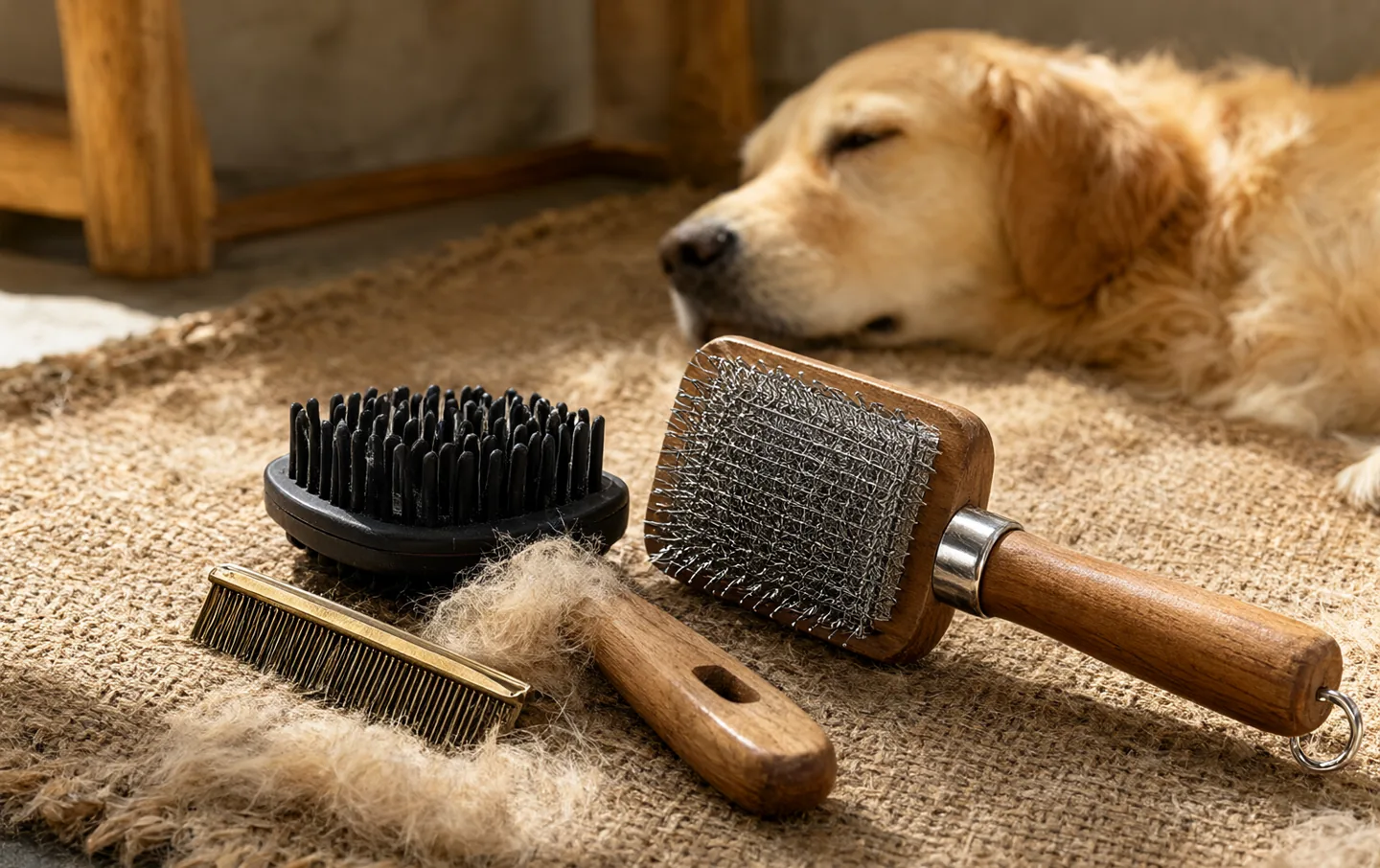
A slicker is the brush to reach for several times a week. The fine wires catch surface hair and small tangles, and the self-cleaning button pushes the collected fur off the pad. It is gentle enough for a dog who tolerates brushing, as long as you let the wires do the work.
It will not clear a dense undercoat on its own. The wires are fine, and pressing hard can scratch skin. Use it in sections, starting at the rear and working forward, and clean the pad before it clogs.
What works
- Fine wires catch loose hair
- Self-cleaning button
- Comfortable handle
- Affordable
What doesn't
- Wires can scratch if pressed
- Not enough for a heavy undercoat
- Self-cleaning mechanism is basic
- Needs regular cleaning
EquiGroomer Deshedding Tool
Best for sensitive dogs and cats who dislike metal blades
The EquiGroomer looks like a small wooden comb with fine teeth. It was designed for horses, which explains the comfortable handle and the gentle action. It pulls loose hair without a blade edge, and nervous dogs tend to accept it.
It is slower than a Furminator on a thick undercoat, and the small head means more strokes. For a dog with sensitive skin or a cat who hates metal, the trade-off is worth it. Use light strokes and clean the teeth often.
What works
- Fine teeth with a wood handle
- Comfortable for nervous pets
- Works on short and medium coats
- Easy to hold
What doesn't
- Slower than a bladed tool
- Not ideal for very dense undercoat
- Wood handle needs care
- Small head takes time
ChomChom Roller
Best for furniture, bedding, and car seats
The ChomChom is a reusable roller with a fabric pad that grabs hair from upholstery. You roll it back and forth, the hair collects in a chamber, and you empty it into the bin. There are no sheets to peel, which makes it the tool that stays by the sofa.
It is not a vacuum. Deep pile carpet and large floors need more than a roller, and fine hair can slip past. For the chair the dog sleeps on, it is the fastest fix here.
What works
- No sticky sheets
- Reusable
- Good on upholstery
- Quick to use
What doesn't
- Labour-intensive on large surfaces
- Not for deep pile carpet
- Needs emptying
- Can miss fine hair
Bissell Pet Hair Eraser Handheld Vacuum
Best for cars, stairs, and corners
A handheld vacuum is the other half of de-shedding: the part where the hair is already on the floor. Bissell's Pet Hair Eraser is built around a rubber nozzle and attachments for upholstery, and it reaches into car seats and stair corners where a roller will not.
Run time is limited on cordless models, and the canister fills quickly in a heavy shed. The noise can frighten a pet, so introduce it while the pet is in another room. Clean the filter regularly or suction drops.
What works
- Designed for pet hair
- Cordless options
- Attachments for upholstery
- Easy to empty
What doesn't
- Short run time
- Small canister
- Noisy for nervous pets
- Filters need cleaning
Match the tool to the coat#
Double coats, like huskies, shepherds, and golden retrievers, have a soft undercoat and a longer guard coat. An undercoat rake or a bladed tool removes the loose undercoat; a slicker finishes the surface. Short coats, like beagles and boxers, shed small hairs that embed in fabric, so a rubber curry and a good vacuum matter more than a blade.
Curly coats, like poodles, do not shed much but mat easily. They need regular clipping and line brushing, not a de-shedding blade. Long silky coats need detangling first, then a gentle slicker.
Do not shave a double-coated dog to reduce shedding. The guard coat insulates against heat and cold, and shaving can change how it grows back. It does not stop the undercoat from shedding, and it can leave the skin exposed. Ask a groomer before changing the coat.
Pressure and frequency#
Brush for five to ten minutes, a few times a week, rather than an hour once a month. Short sessions are easier on the dog and easier to fit in. Use light pressure and let the tool do the work; if the dog flinches or the skin looks red, stop.
De-shedding works best after a bath and a blow-dry, when the undercoat is loose. A conditioner can help release it. Do not brush a matted coat with a de-shedding tool; work out the mats first or see a groomer.
Cleanup#
Fur travels. A roller by the sofa, a handheld vacuum by the door, and a washable throw on the dog's favourite chair will do more for the house than any single tool. Wash bedding weekly during a heavy shed, and clean vacuum filters so suction stays strong.
Questions people actually ask#
Do de-shedding tools stop shedding?#
No. They remove loose hair before it falls, which makes the house easier to clean, but the coat will keep cycling. Expect less fur on the floor, not none.
Can I use a Furminator on a cat?#
Some models are marketed for cats, but cats have thinner skin and many dislike the blade. Use a gentle rake or a slicker instead, and stop if the cat objects. Never use a dog-sized blade on a cat.
How often should I de-shed my dog?#
Once or twice a week for most coats, more often during a seasonal shed. Short sessions are better than long ones. If the skin looks irritated, give it a rest and ask your vet or groomer.