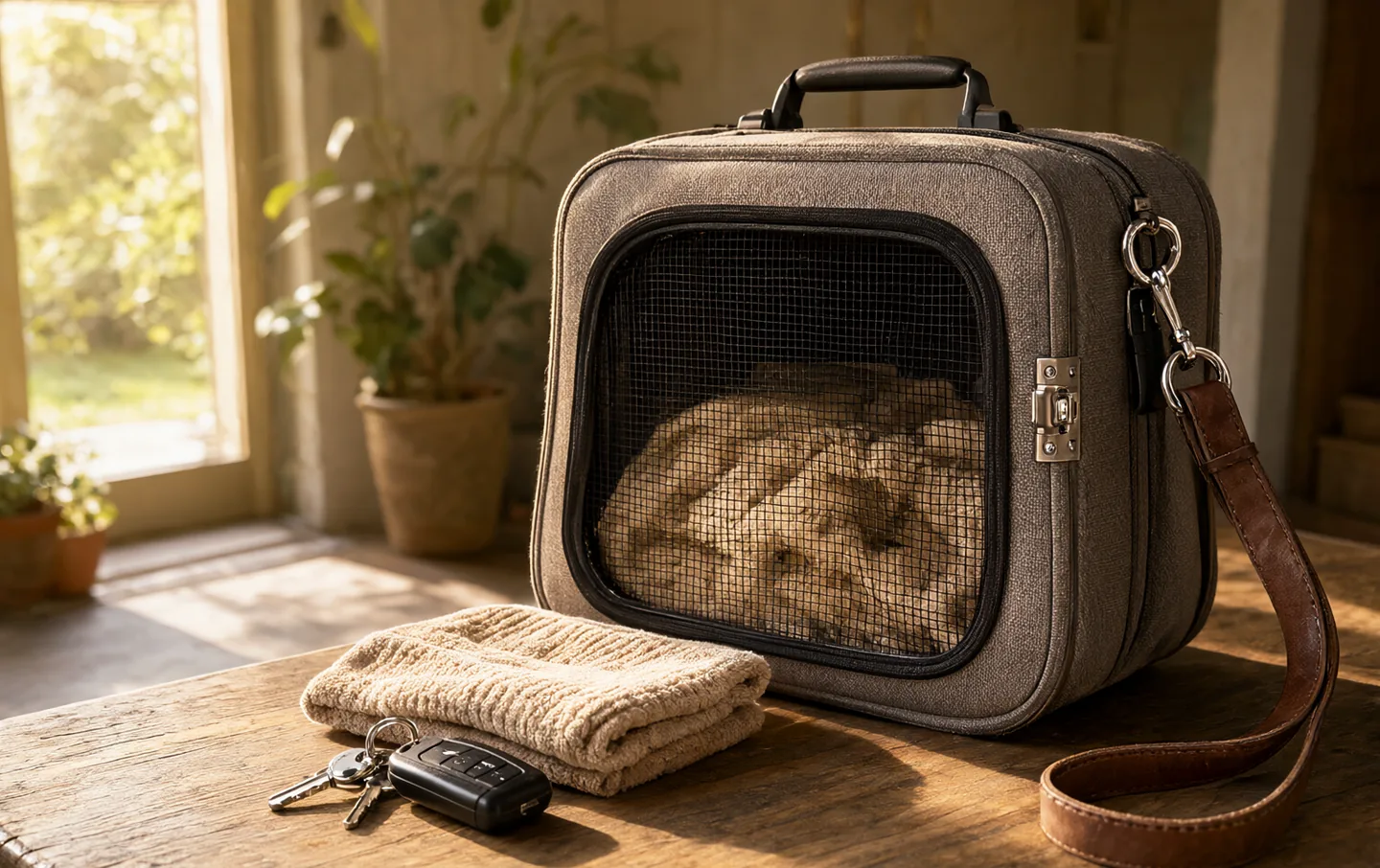
Most cats and small dogs hate the vet because the carrier only appears when something unpleasant is about to happen. A carrier that lives on the floor with a blanket inside, opens from the top, and does not rattle is already halfway to a calmer visit. The rest is handling.
We looked at opening styles, size, washability, and how each carrier is meant to be secured in a car. We are not crash-testing anything ourselves, and we treat “airline approved” as a statement about cabin dimensions, not safety.
The short version#
The Diggs Passenger is the carrier we would buy for a cat who fights the door. The Sleepypod Air is the safety pick for car travel. The Sherpa Original Deluxe is the airline standby, the SturdiBag is the light travel bag, and the PetAmi is the budget option that still opens wide.
The short list#
Diggs Passenger Travel Carrier
Best for cats and small dogs who hate being stuffed into a bag
The Passenger opens from the top and the front, which changes the whole vet-day routine. You can lower a cat in from above, or let them walk out onto the table, instead of tipping the carrier and shaking. The pad comes out for washing, and the frame holds its shape when you pick it up.
It is certified by the Center for Pet Safety, which is the clearest third-party crash-test mark in this category. That certification applies to a correctly installed carrier, using the seatbelt routing. It is heavy and does not fold flat, and the single size tops out around 18 pounds. Measure your cat before ordering.
What works
- Top and front openings
- Crash-test certified by the Center for Pet Safety
- Removable, washable pad
- Seatbelt routing built in
What doesn't
- Expensive
- Heavy and bulky to store
- One size only
- Too small for a large cat
Sleepypod Air
Best for car travel and cabin flights
The Air is a soft carrier designed around car travel. It compresses from about 22 inches to 16 to fit airline cabin limits, and it has a seatbelt path for car travel. The bedding is plush and washable, and the top opens so a pet can be lifted out without a struggle.
It is certified by the Center for Pet Safety, with reports of a four-star result rather than a perfect score. The certification depends on installing it correctly, which means reading the instructions and using the belt path, not just setting it on the seat. The soft sides offer less structure than a crate, and the size limit is real.
What works
- Center for Pet Safety certified
- Compresses for cabin sizing
- Top and end openings
- Washable plush bedding
What doesn't
- Expensive
- Soft sides need correct routing
- Not for pets over about 17 pounds
- Interior gets warm
Sherpa Original Deluxe Carrier
Best for cabin travel on major airlines
The Sherpa Original Deluxe is the bag airline staff see most often. It has a spring-wire frame, mesh panels, and a shape that fits under most cabin seats. Some sizes open from the top as well as the front, which helps at security and at the vet.
It is not crash-tested, and the padding is thin. The frame can sag after a few years, and the sizing is optimistic; a cat who fits the label may not fit the bag comfortably. For cabin travel, check your airline's current dimensions rather than trusting the tag.
What works
- Familiar airline-approved shape
- Mesh panels on three sides
- Top and front entry on some sizes
- Affordable
What doesn't
- Not crash-tested
- Thin padding
- Sizes run small
- Frame can sag over time
SturdiBag Pet Carrier
Best for light packers and short trips
The SturdiBag is the carrier that disappears into a suitcase. It weighs very little, folds flat, and comes in sizes from small cat to small dog. The mesh gives good airflow, and the fleece pad is removable.
The trade-off is structure. The frame is flexible, so the bag collapses against a pet in a tight space, and there is no crash certification. The zippers are the part that fails first. It is a good second carrier for travel and a poor choice for a pet who panics or chews.
What works
- Very light
- Folds flat
- Multiple sizes
- Mesh panels and a fleece pad
What doesn't
- No crash certification
- Soft frame offers little protection
- Zippers are the weak point
- Not for a chewer
PetAmi Pet Carrier
Best for a spare carrier or a tight budget
PetAmi makes the affordable carrier that shows up in a lot of homes. It has mesh panels, a fleece pad, and several ways in, including a top opening on some models. For a cat who needs a carrier in every room, the price makes that possible.
The frame is soft and the straps are basic. It is not a car-safety product, and the sizes vary between models, so measure the interior rather than trusting the label. It works as a vet-visit bag and a spare, not as the carrier you rely on in a collision.
What works
- Cheap
- Multiple openings
- Washable fleece pad
- Backpack and shoulder options
What doesn't
- Flimsy frame
- No crash testing
- Sizing is inconsistent
- Straps feel basic
Carrier, crate, or car seat#
A carrier is for carrying a pet into a building and for keeping them contained in a car. A crate is for a larger dog, and it needs to be strapped down or wedged so it does not become a projectile. A car seat or booster is a bed with a tether; it is not a crash-test device unless the maker can show certification.
For a cat or small dog, a soft carrier with a seatbelt path is a reasonable compromise. Route the belt through the designated loop, not around the handles, and put the carrier on the seat rather than in the footwell. For a larger dog, a crash-tested crate or harness is the better tool. The Center for Pet Safety publishes certified products; check the current list rather than a retailer's badge.
Quiet entry, size, and washing#
Leave the carrier out with a blanket inside for a week before the vet. Feed treats near it, then in it. A carrier that only appears on vet day is a carrier that predicts trouble.
The pet should be able to stand, turn around, and lie down. For a cat, that usually means a carrier at least 18 inches long, and more for a large cat. Check the interior dimensions, not the exterior. A carrier that is too small is uncomfortable; one that is too large lets a pet slide around in the car.
Look for a removable, machine-washable pad and a wipeable interior. Accidents happen, and a carrier that cannot be cleaned will smell like the last vet visit. Wash the pad after every trip and wipe the frame with a pet-safe cleaner.
Questions people actually ask#
Is a soft carrier safe in a car?#
Only if it is secured with a seatbelt or tether and has been designed for that use. A soft carrier loose on a seat is a projectile. Look for a crash-test certification and follow the installation instructions exactly.
How do I get a cat into a carrier without a fight?#
Leave the carrier out as furniture, with a familiar blanket and treats. Pick the cat up with support under the chest and hindquarters, and lower them in through a top opening. Do not tip the carrier or chase the cat; that teaches them to fear it more.
Does airline-approved mean crash-tested?#
No. Airline approval is about fitting under a seat and meeting carrier rules. Crash testing is a separate standard, and most soft carriers have not been through it. Check for a Center for Pet Safety certification if car travel matters.