The chaos usually starts before the car moves. A dog loose in the back seat climbs over the luggage, pants at the window, and tries to sit on the driver. Restraint is the first fix, and it is also the part most people get wrong.
We looked at harnesses and crates with documented crash testing, plus the small gear that makes a long drive easier. We are not testing these in a crash, and we are careful about the difference between a manufacturer's test and third-party certification.
The short version#
The Sleepypod Clickit Sport is the harness with the strongest certification. The Kurgo Impact is the heavy-duty alternative, the Ruffwear Load Up is the comfortable everyday option, the Kurgo Loft Wander Bed gives a dog a familiar place to settle, and the Ruffwear Bivy Bowl handles water stops.
The short list#
Sleepypod Clickit Sport
Best for dogs who ride in the back seat
The Clickit Sport is one of the few harnesses certified by the Center for Pet Safety, and it earned a five-star rating in that testing. It is a vest-style harness with two loops on the back; the seatbelt passes through both, which spreads the load across the chest rather than the neck.
The fit has to be right. A loose harness lets the dog move too far forward, and a tight one restricts breathing. Measure the girth and follow the size chart, then check the fit with the dog standing. It is not a harness for leaving on all day in hot weather.
What works
- Center for Pet Safety certified
- Five-star crash-test rating
- Padded vest style
- Seatbelt routes through two loops
What doesn't
- Expensive
- Must fit snugly to work
- Can be warm in summer
- Sizing takes care
Kurgo Impact Dog Car Harness
Best for large dogs and long highway drives
The Impact is Kurgo's serious car harness. It uses steel hardware and heavy webbing, and Kurgo says it was tested at Calspan to the child-restraint standard for dogs up to about 108 pounds. That is a manufacturer test, not a Center for Pet Safety certification, and the distinction matters.
It is heavy and takes a moment to put on, because the dog steps through the harness and it goes over the head. Some dogs dislike that. For a big dog on a long drive, the structure is reassuring, but it still needs to be fitted correctly and attached to the seatbelt.
What works
- Steel buckles and strong webbing
- Tested at Calspan to FMVSS 213
- Sizes up to about 108 pounds
- Padded chest plate
What doesn't
- Heavy
- Goes on over the head
- Not CPS-certified
- Bulky for short trips
Ruffwear Load Up Harness
Best for dogs who need padding and adjustability
The Load Up is designed for car travel and long days out. It has a broad belly panel, padded chest, and metal hardware, and Ruffwear says it was dynamically tested to FMVSS 213 at an independent facility. It is not certified by the Center for Pet Safety.
The padding makes it comfortable for a dog who will wear it for hours, but also warm. It is bulkier than a walking harness and takes longer to adjust. The seatbelt loop is easy to use, and the harness can stay on during rest stops. Fit it snugly, with room for two fingers under the chest strap.
What works
- Padded throughout
- Strength-rated hardware
- Four points of adjustment
- Seatbelt loop on the back
What doesn't
- Not CPS-certified
- Can be warm
- Bulkier than a walking harness
- Sizing runs specific
Kurgo Loft Wander Bed
Best for hotel rooms and camping
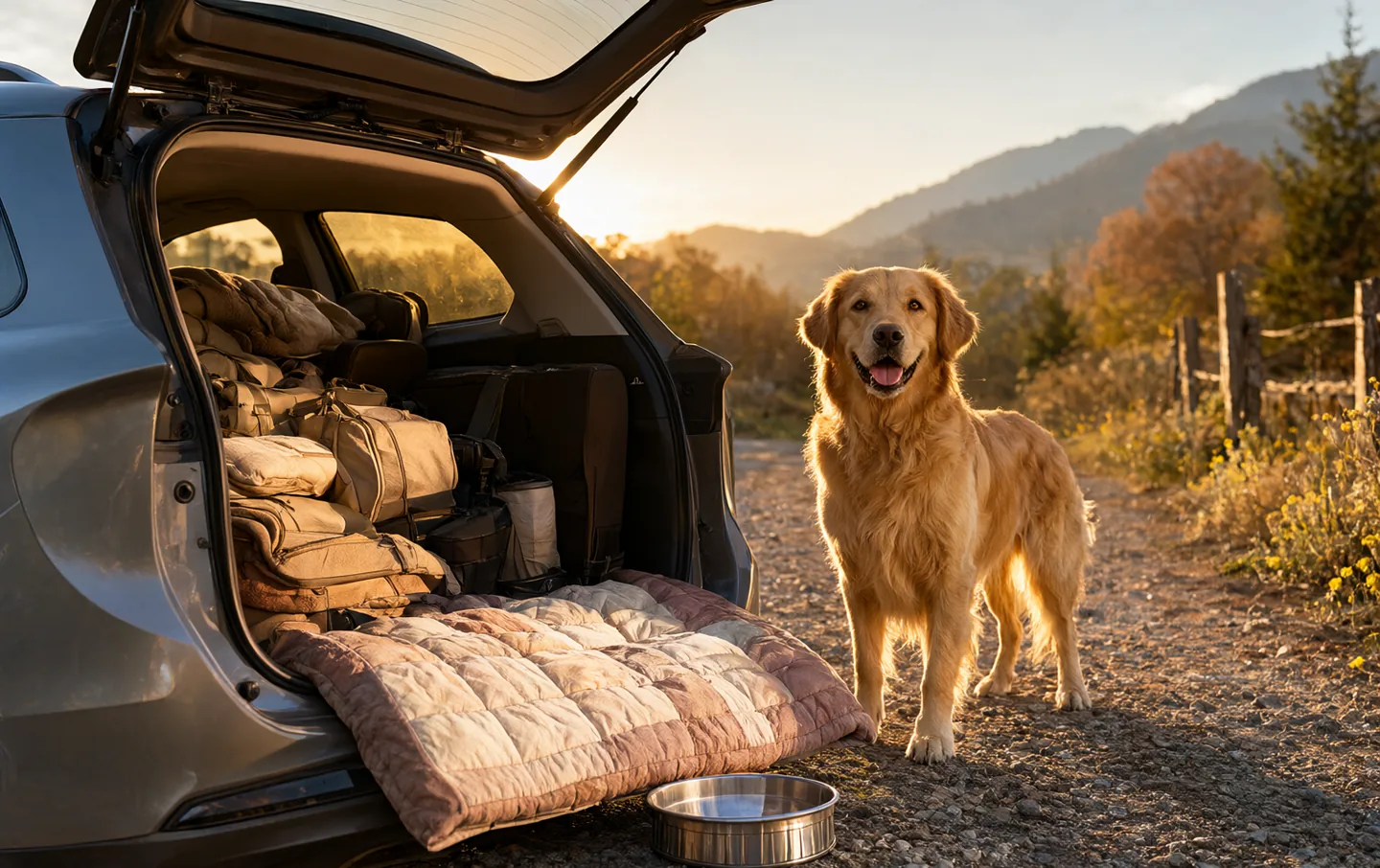
A familiar bed makes a strange hotel room less strange. The Loft Wander Bed rolls up, has a water-resistant base, and the cover comes off for washing. It is light enough to carry from the car to a rental.
It is not a safety device and it is not thick enough for a dog with joint pain. Think of it as a portable place to settle, not a replacement for the bed at home. If your dog is restless in new places, bring the bed they already use and a worn T-shirt.
What works
- Rolls up with a strap
- Water-resistant base
- Machine-washable cover
- Familiar smell for a nervous dog
What doesn't
- Not crash protection
- Thin for older joints
- Takes boot space
- Cover can shift
Ruffwear Bivy Bowl
Best for hikes, rest stops, and the car floor
The Bivy Bowl is a fabric bowl that collapses flat and opens into a water dish. It is the bowl that lives in the car door, so a rest stop does not involve improvising with a coffee cup. The base is weighted enough for a calm dog.
It tips if a dog paws at it, and it does not hold enough water for a long day without refilling. It is a convenience, not a hydration system. Bring a bottle too, and offer water at every stop rather than waiting for the dog to look thirsty.
What works
- Collapses flat
- Leak-resistant
- Easy to clip to a pack
- Holds enough for a break
What doesn't
- Tips if a dog paws it
- Not for all-day water
- Small capacity
- Needs a stable surface
Crate or harness#
A crate is the better choice for a dog who is comfortable in one, especially a large dog. It needs to be strapped down or wedged so it cannot slide, and it should be sized so the dog can stand and turn. A crate that is loose in the back is a heavy object in a crash.
A harness is easier to live with and takes less space. Use one that has been crash-tested, and attach it to the seatbelt according to the instructions. A harness attached to a tether that is too long lets the dog reach the front seat; too short and they cannot lie down.
Do not put a dog in the front seat with a passenger airbag. The back seat or a secured crate in the cargo area is safer. If you use a hammock or seat cover, remember that it is comfort, not restraint.
Motion sickness, breaks, and heat#
Some dogs drool, pant, or vomit in the car. Puppies often outgrow it, and a vet can advise on medication or a feeding schedule. Do not give human anti-nausea drugs without asking a vet, and do not feed a big meal right before a long drive.
Stop every two hours for water, a walk, and a bathroom break. Keep the dog leashed at rest stops, and never leave a dog in a parked car in warm weather. Cracking the windows is not enough. If you are traveling in heat, plan the drive around the coolest hours and bring shade.
Packing#
Bring food in a sealed container, a collapsible bowl, a bottle of water, a leash, waste bags, any medication, and a towel. A familiar blanket and a chew toy help a dog settle. Pack the dog's gear where it cannot slide onto them, and keep the crate or harness area clear.
Questions people actually ask#
Is a harness or a crate safer in the car?#
A crash-tested harness or a secured crate are both reasonable. The best choice is the one your dog will tolerate and that you will install correctly every time. A loose crate or an untested harness is not protecting anyone.
How do I stop my dog getting carsick?#
Feed a light meal a few hours before travel, keep the car cool, and stop often. If it continues, ask your vet about treatment. Do not use human medication without veterinary advice.
Can my dog ride with their head out the window?#
It is better not to. Debris can injure the eyes and ears, and a dog can slip or jump. Keep the window low enough for air, not low enough for a head.