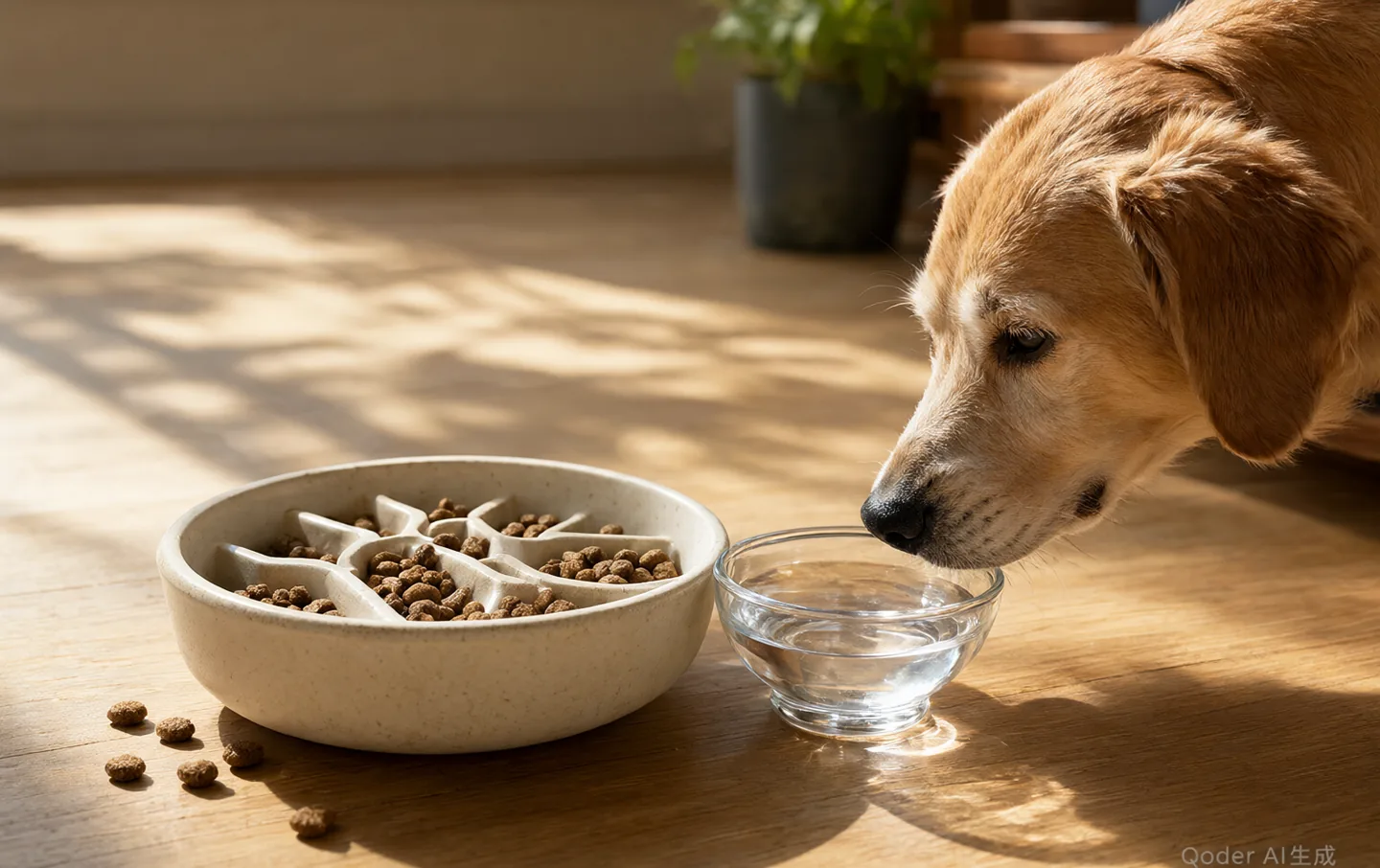
Some dogs eat as if the food is about to be taken away. A slow feeder does not fix the reason, but it changes the mechanics: the dog has to work around ridges, lick, or nose the food out, and a meal that took forty seconds takes five minutes. That can be enough to make dinner less of a race.
We looked at how each design slows eating, how easy it is to clean, and whether it creates frustration instead of solving it. None of these is a medical device, and none is a substitute for talking to a vet if a dog is gulping, regurgitating, or losing weight.
The short version#
The Outward Hound Fun Feeder is the starting point for most dogs. The LickiMat is best for wet food and calm licking, the West Paw Toppl is the most versatile, the Paw5 Wooly Snuffle Mat turns a meal into a search, and the Trixie Poker Box is for a dog who needs a real puzzle.
The short list#
Outward Hound Fun Feeder Slo Bowl
Best for dry food and dogs who gulp
The Fun Feeder is the bowl most people picture when they think of a slow feeder. The ridges are deep enough that a dog has to use their tongue and nose, not just scoop. It works with kibble and with small treats, and the larger sizes suit big dogs.
The maze is also a trap for old food. Bits lodge in the corners, and hand-washing takes a brush and patience. It goes on the top rack of a dishwasher, which is the practical way to own one. A determined dog may learn to flip the bowl; a non-slip base helps.
What works
- Deep maze ridges
- Wide range of sizes
- Dishwasher safe on top rack
- Cheap enough to buy two
What doesn't
- Hard to clean by hand
- Too easy for some dogs
- Not for wet food
- Large size is bulky
LickiMat Classic
Best for wet food, yogurt, and peanut butter
A LickiMat is less a slow feeder than a way to make soft food last. You spread wet food, plain yogurt, or peanut butter across the textured surface, and the dog licks instead of gulps. It is useful for a dog who eats too fast, and for occupying a dog during a bath or a nail trim.
It does not work for kibble unless you press the kibble into the texture, and it is not a meal-sized solution for a large dog. The silicone picks up smells, so wash it promptly and let it dry fully. Freeze it for a longer distraction on a hot day.
What works
- Great for soft food
- Calming licking
- Freezer friendly
- Light and packable
What doesn't
- Not a dry-food solution
- Silicone holds odours
- Small surface area
- Some dogs chew the mat
West Paw Toppl
Best for frozen meals and dogs who need a challenge
The Toppl is a hollow rubber toy with a wide opening. Stuff it with wet food and freeze it, and a dog has to work at it for a while. Two sizes snap together to make a bigger puzzle, and the rubber survives most chewers.
It is not a replacement for a bowl at every meal, and the small size is a five-minute toy for a medium dog. It rolls, which is part of the challenge and part of the annoyance when it ends up under the sofa. It is the most useful piece here for a dog who needs to be occupied rather than just slowed down.
What works
- Freezable
- Two sizes connect
- Durable rubber
- Works with wet or dry food
What doesn't
- Not a flat bowl
- Small size is too easy
- Can roll under furniture
- Pricier than a plastic bowl
Paw5 Wooly Snuffle Mat
Best for bored dogs and kibble that needs to be earned
A snuffle mat is a shaggy square of fleece strips. You scatter kibble into it, and the dog noses through the fabric to find dinner. It slows eating more than a maze bowl for some dogs, and it gives a bored dog a job.
The fleece holds crumbs and hair, so shake it out after every meal and wash it regularly. A dog who chews fabric can pull the strips loose, which is a choking risk; supervise the first few uses. It is not the tool for a dog who eats wet food.
What works
- Turns a meal into a search
- Soft fleece strips
- Machine washable
- Slows eating without a bowl
What doesn't
- Fleece traps crumbs
- Can be shredded by a chewer
- Takes space on the floor
- Not ideal for wet food
Trixie Poker Box
Best for smart dogs who empty a maze bowl in a minute
The Poker Box is a puzzle feeder rather than a slow bowl. It has drawers, flaps, and compartments, and a dog has to work out how to open each one. For a dog who solves a maze bowl in a minute, it adds actual problem-solving.
It can also cause frustration. Start with the easiest compartment and let the dog succeed, rather than presenting the whole box at once. The plastic is sturdy but not indestructible, and a determined chewer can crack a flap. Use it for part of a meal and supervise.
What works
- Several compartments and drawers
- Adjustable difficulty
- Works for treats and kibble
- Wipes clean
What doesn't
- Too hard for some dogs
- Plastic can crack
- Needs supervision
- Not a full meal for a big dog
Bowl, mat, or puzzle#
A maze bowl is the simplest change and the easiest to live with. It works for dry food and most dogs, and it does not require you to be in the room. A licking mat or stuffable toy is better for wet food and for calming a dog down. A puzzle is for mental work, not for every meal.
Match the difficulty to the dog. A dog who gives up and walks away is not being stubborn; the feeder is too hard. A dog who flips the bowl is not being naughty; the feeder is too easy. Start easy and size up.
There is no evidence that a slow feeder prevents bloat. It may slow eating, which some owners find reassuring, but bloat is a medical emergency with complex causes. If your dog has had bloat or is a high-risk breed, talk to your vet about a plan rather than relying on a bowl.
Cleaning and frustration#
Maze bowls need a brush and hot water, or a dishwasher. Silicone mats need washing after wet food and full drying before storage. Snuffle mats need shaking and machine washing. A feeder that stays dirty is worse than a plain bowl.
Watch for frustration signals: barking at the bowl, walking away, or gulping harder. A slow feeder should make a meal interesting, not stressful. If a dog is losing weight or regurgitating meals, stop guessing and see a vet.
Questions people actually ask#
Do slow feeders actually slow eating?#
They can, especially maze bowls and snuffle mats, but the effect varies by dog. A determined dog may learn to flip a bowl or scoop with a paw. Measure the change rather than assuming it works.
Are slow feeders good for every dog?#
No. Puppies, flat-faced breeds, and dogs with dental problems may struggle. A dog who gets frustrated or guards the feeder may do better with a simpler setup. Ask your vet if your dog has a health condition.
Can I use a slow feeder with wet food?#
A licking mat or stuffable toy works better than a maze bowl for wet food. Maze bowls are designed for kibble, and wet food smears into the corners and is hard to clean out.